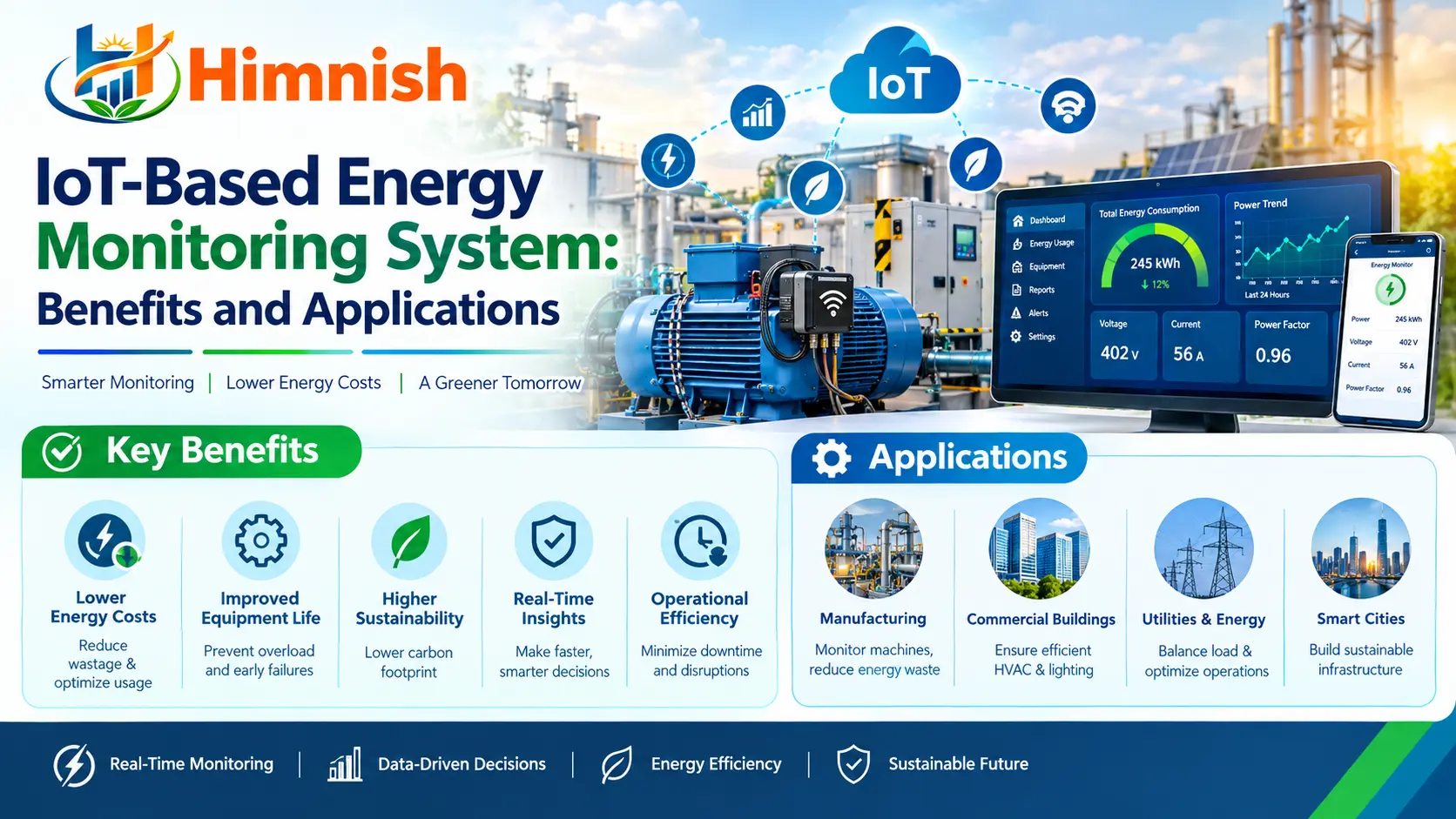
Energy consumption has become an important concern for industries, commercial buildings, and manufacturing facilities. Rising electricity costs, increasing operational demands, and the need for better energy efficiency are encouraging businesses to adopt smarter monitoring technologies. An IoT-based energy monitoring system provides a practical way to track electricity usage, identify energy wastage, and make informed decisions about energy consumption.
By connecting electrical meters, sensors, communication devices, and monitoring software, businesses can access energy data in near real time. This information helps facility managers understand consumption patterns, detect unusual changes, and improve the overall efficiency of electrical systems.
In this blog, we will explore how an IoT-based energy monitoring system works, its key benefits, major applications, and the role of IoT in modern energy management.
What Is an IoT-Based Energy Monitoring System?
An IoT-based energy monitoring system is a connected solution that collects and analyzes energy consumption data from electrical equipment, machines, buildings, or entire industrial facilities. It uses Internet of Things (IoT) technology to transfer data from connected devices to a centralized monitoring platform.
Depending on the equipment and system configuration, it can track parameters such as voltage, current, power consumption, power factor, and energy usage in kilowatt-hours (kWh). Some advanced solutions can also monitor demand patterns, equipment operating hours, and selected power-quality parameters.
Unlike conventional systems that rely on periodic meter readings, IoT-enabled monitoring can provide frequent updates and historical records. Users can access this information through dashboards, computers, or mobile devices, depending on the platform.
The primary objective is not simply to measure electricity consumption but to understand where, when, and how energy is being used. This information allows organizations to identify inefficiencies and develop more effective energy-saving strategies.
Also Read: Industrial Remote Monitoring: Benefits, Working, Applications and Use Cases
How Does an IoT-Based Energy Monitoring System Work?
An IoT energy monitoring solution typically involves four main stages.
1. Data Collection Through Smart Meters and Sensors
The process begins with smart energy meters, current sensors, or compatible electrical monitoring devices. These instruments collect information about the electrical parameters of connected equipment, circuits, or buildings.
For example, a manufacturing facility may monitor the electricity consumption of individual production lines, compressors, pumps, and HVAC systems to understand their contribution to total energy usage.
2. Data Transmission Through IoT Connectivity
The collected information is transferred to a central platform using suitable communication technologies. Depending on the installation, these may include Ethernet, Wi-Fi, cellular networks, or industrial communication protocols.
Gateways may be used to connect multiple meters and devices to the monitoring platform.
3. Data Analysis and Visualization
Energy data is processed and displayed through dashboards, reports, graphs, and consumption summaries. Users can compare energy usage across different machines, shifts, departments, or time periods.
This visibility helps identify unusual consumption patterns and equipment that may be operating inefficiently.
4. Alerts and Energy Optimization
The system can generate notifications when energy consumption exceeds a defined threshold or when a monitored parameter changes unexpectedly.
Maintenance and facility teams can investigate the cause and take appropriate action. Some systems also support integration with building management or industrial control platforms for automated responses, where properly designed and authorized.
Key Benefits of IoT for Energy Management
Implementing IoT for energy management can help organizations move from estimated consumption figures to data-driven decisions.
1. Real-Time Energy Consumption Monitoring
One of the biggest advantages is the ability to observe electricity usage without depending entirely on manual meter readings.
Facility managers can identify periods of high consumption, compare equipment performance, and understand how energy demand changes throughout the day. This information supports faster responses to unexpected consumption increases.
2. Reduced Electricity Costs
Unnecessary equipment operation, inefficient machinery, and poor scheduling can increase electricity expenses.
With better consumption visibility, businesses can identify equipment that consumes excessive energy or remains active outside working hours. They can then adjust operating schedules, improve maintenance practices, and eliminate avoidable usage.
Actual savings depend on the facility, baseline consumption, electricity tariffs, and the corrective actions taken.
3. Improved Energy Efficiency
Energy efficiency requires an understanding of how much electricity different operations consume and whether that consumption is justified by their output.
An IoT-based system can help compare energy usage across machines or production periods. Businesses may use these insights to identify inefficient processes, investigate equipment performance, and optimize operating conditions.
This makes energy management in IoT environments more practical because decisions are supported by measurable data.
4. Early Detection of Abnormal Consumption
Sudden changes in electrical consumption may indicate equipment malfunction, inefficient operation, or an unexpected load.
A properly configured monitoring system can flag unusual readings and help maintenance teams investigate the underlying cause. Early detection may reduce unnecessary energy use and prevent minor issues from becoming more expensive operational problems.
However, an energy monitoring system does not automatically diagnose every fault; the quality of detection depends on available data, thresholds, and analytical capabilities.
5. Better Equipment and Maintenance Planning
Electrical motors, pumps, compressors, and HVAC equipment can consume significant amounts of energy in industrial and commercial facilities.
Monitoring their consumption over time helps maintenance teams identify unusual trends and prioritize inspections. When integrated with condition-monitoring data, energy information can also contribute to a broader equipment maintenance strategy.
6. Data-Driven Energy Reporting
Historical records make it easier to compare consumption between months, shifts, production batches, or departments.
Businesses can use these reports to evaluate energy-saving initiatives, establish consumption baselines, and track progress toward internal efficiency targets.
This approach also supports more consistent energy reporting and accountability across teams.
Major Applications of IoT in Energy Management
IoT-based energy monitoring can be implemented across several industries, although the system configuration varies according to the application.
1. Manufacturing and Industrial Facilities
Manufacturing plants can monitor electricity usage across production lines, motors, compressors, pumps, and other machinery.
The collected data helps identify energy-intensive processes and compare consumption with production output. Industrial managers can use these insights to improve operating schedules and reduce unnecessary energy consumption.
2. Commercial Buildings and Offices
Offices, shopping centres, hotels, and commercial complexes use electricity for lighting, elevators, computers, and air-conditioning systems.
IoT monitoring helps facility managers understand consumption patterns and identify equipment operating outside required hours. When integrated with suitable building management systems, it can support more efficient control of lighting and HVAC operations.
3. Hospitals and Healthcare Facilities
Hospitals require reliable electricity for lighting, ventilation, medical equipment, laboratories, and other essential services.
Energy monitoring helps facility teams observe consumption across selected departments and supporting systems. It can reveal unusual demand patterns while supporting efforts to maintain efficient operations without compromising essential services.
4. Data Centres
Data centres consume substantial electricity through servers, cooling equipment, and power infrastructure.
IoT-enabled monitoring can provide visibility into energy demand across supported equipment and cooling systems. This information helps operators investigate inefficiencies, track performance, and make informed decisions about energy optimization.
5. Renewable Energy Installations
Solar installations and other renewable energy systems can use connected monitoring devices to track selected generation, consumption, and system-performance parameters.
When generation and consumption data are available together, businesses can better understand energy flows and evaluate how effectively renewable electricity is being utilized.
6. Smart Buildings and Campuses
Large campuses, educational institutions, and multi-building facilities often have different energy requirements across their locations.
Centralized monitoring enables authorized teams to compare building-level consumption, identify unusual demand, and prioritize energy-saving opportunities.
IoT-Based Energy Monitoring vs Traditional Energy Monitoring
Traditional energy monitoring generally depends on conventional meters and periodic manual readings. While this method can be suitable for basic requirements, it may provide limited visibility into short-term consumption changes.
An IoT-enabled system can offer more frequent data collection, remote access, automated reporting, and configurable alerts. It can also support analysis across multiple equipment groups or locations.
However, traditional monitoring may be sufficient for smaller facilities with straightforward energy requirements. Businesses should select a system based on their monitoring needs, budget, and expected operational benefits rather than adopting connected technology without a clear objective.
Challenges to Consider Before Implementation
Although energy management IoT solutions offer several advantages, organizations should consider a few important factors before deployment.
- Installation and integration: Existing electrical infrastructure, meters, and control systems must be evaluated for compatibility.
- Data accuracy: Appropriate meter selection, installation, calibration, and maintenance are essential for reliable readings.
- Cybersecurity: Connected devices should use suitable access controls, secure communication, network protection, and regular software updates.
- Initial investment: Hardware, connectivity, software, and integration costs should be assessed against the expected benefits.
- Staff training: Employees should understand how to interpret energy reports and translate monitoring insights into practical improvements.
Addressing these considerations helps businesses build a reliable and useful monitoring system.
The Future of IoT in Energy Management
The role of IoT in energy management is expanding as organizations seek better visibility into electricity consumption and operational performance.
Advanced analytics, artificial intelligence, and automated control can help businesses identify consumption patterns and improve energy planning. Integration with renewable energy systems, battery storage, and smart building platforms can further support coordinated energy use.
As these technologies develop, iot for energy management is likely to become increasingly valuable for organizations looking to make their operations more efficient and responsive.
The greatest benefit will come from combining reliable monitoring data with practical actions, rather than relying on technology alone.
Conclusion
An IoT-based energy monitoring system helps businesses understand electricity consumption, identify inefficiencies, and improve energy-related decision-making. From industrial plants and commercial buildings to hospitals and renewable energy installations, connected monitoring provides useful insights into how energy is consumed across different operations.
By adopting an appropriate monitoring strategy, organizations can improve visibility, support maintenance planning, and identify opportunities to reduce unnecessary energy use.
For businesses exploring smarter industrial monitoring and energy-related solutions, Himnish Projects can be a starting point for understanding suitable technologies and system requirements.
Ultimately, effective energy management depends on accurate data, secure connectivity, clear objectives, and consistent action. When these elements work together, IoT-based monitoring can become a valuable part of a long-term energy efficiency strategy.