Industrial equipment plays a critical role in manufacturing plants, power stations, processing facilities, and other industrial environments. When a machine stops working unexpectedly, it can interrupt production, increase operating costs, and create safety concerns. This is why choosing the right maintenance strategy is essential for improving equipment reliability and maintaining smooth operations.
Traditionally, industries have relied on scheduled inspections and routine servicing to keep machinery in good condition. However, modern industrial monitoring systems are changing how businesses manage equipment performance. These systems help track operating conditions, identify unusual behaviour, and provide useful information for making timely maintenance decisions.
Understanding industrial monitoring systems vs traditional maintenance can help businesses choose an approach that matches their operational requirements, budget, and long-term goals. In this guide, we explore how both methods work, their advantages, limitations, and why combining monitoring and maintenance can be beneficial for industrial facilities.
What Are Industrial Monitoring Systems?
Industrial monitoring systems are technologies designed to observe equipment performance and operating conditions in real time or at regular intervals. They collect data from sensors, instruments, controllers, and connected devices to help operators understand how machinery is performing.
Depending on the application, an industrial monitoring system may track temperature, pressure, vibration, humidity, energy consumption, flow rate, or other important parameters. The collected information can be displayed on dashboards, control panels, or supervisory systems, allowing teams to identify abnormal conditions before they develop into serious problems.
For example, if a motor begins vibrating more than usual, a monitoring system can highlight the change. Maintenance personnel can then inspect the equipment and determine whether corrective action is necessary.
Industrial monitoring solutions are commonly used in manufacturing plants, utility facilities, warehouses, process industries, and infrastructure projects where equipment reliability and operational visibility are important.
Also Read: IoT Based Real Time Motor Condition Monitoring System
What Is Traditional Industrial Maintenance?
Traditional maintenance generally involves scheduled servicing, manual inspections, and repairs performed after equipment failure. Maintenance teams follow established schedules based on operating hours, manufacturer recommendations, or previous maintenance records.
This approach has been widely used because it is straightforward to implement and does not always require advanced monitoring technology.
Traditional industrial maintenance commonly includes three methods:
1. Preventive Maintenance
Preventive maintenance involves inspecting, servicing, lubricating, or replacing components at planned intervals. Its purpose is to reduce the likelihood of unexpected equipment failure.
2. Reactive Maintenance
Reactive maintenance takes place after a machine develops a fault or stops working. The team identifies the problem and carries out the necessary repair or replacement.
3. Manual Equipment Inspection
Technicians periodically examine machinery, check operating conditions, listen for unusual noises, and look for visible signs of wear, leakage, or damage.
Although these methods remain useful, they may not always identify developing faults between scheduled inspections.
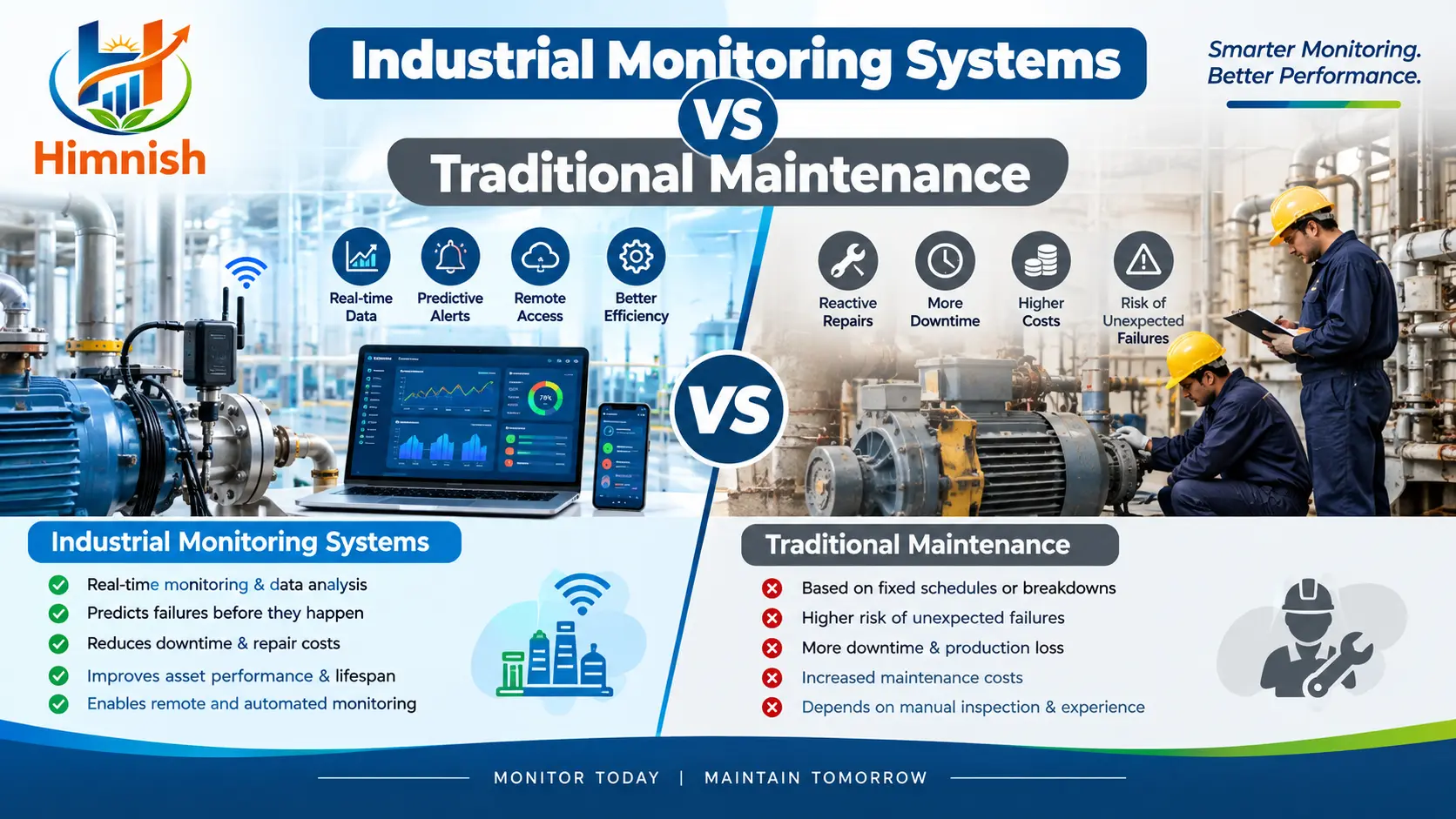
Industrial Monitoring Systems vs Traditional Maintenance: Key Differences
Both approaches aim to maintain equipment reliability, but they differ in how problems are identified and how maintenance activities are planned.
| Comparison Factor | Industrial Monitoring Systems | Traditional Maintenance |
|---|---|---|
| Fault identification | Uses sensor data and operating trends to identify abnormal conditions | Relies mainly on scheduled checks or visible signs of failure |
| Monitoring frequency | Can provide continuous or frequent data collection | Usually performed at planned intervals |
| Maintenance planning | Supports condition-based maintenance decisions | Often follows fixed schedules or responds to failures |
| Equipment visibility | Provides measurable operating data and trends | Depends more on inspection records and technician observations |
| Initial investment | May require sensors, software, installation, and integration | Often requires less technology investment |
| Labour requirements | Can reduce routine manual data collection | May require frequent manual inspections |
| Downtime management | Can help identify developing problems earlier | Unexpected failures may occur between inspections |
| Best suited for | Critical equipment and operations needing greater visibility | Simpler machinery and equipment with predictable service needs |
The best choice depends on equipment criticality, process complexity, maintenance resources, and the cost of unexpected downtime.
Benefits of Industrial Monitoring Systems
Modern industrial monitoring systems provide several advantages for businesses that want better control over their equipment and processes.
1. Early Identification of Equipment Problems
One of the main advantages of industrial monitoring is the ability to detect unusual operating conditions. Changes in vibration, temperature, pressure, or energy consumption may indicate that equipment requires attention.
Identifying these changes early gives maintenance teams an opportunity to investigate the cause and schedule repairs when appropriate.
2. Reduced Unplanned Downtime
Unexpected breakdowns can disrupt production schedules and affect delivery commitments. Monitoring equipment performance helps teams identify potential issues before they lead to major failures.
Although monitoring cannot eliminate every breakdown, it can improve fault visibility and support better maintenance planning.
3. Better Maintenance Planning
Maintenance teams can use monitoring data to prioritize inspections and allocate resources more effectively. Instead of servicing every component solely according to a fixed timetable, they can consider actual operating conditions and equipment history.
This approach can help reduce unnecessary maintenance activities while ensuring that important equipment receives appropriate attention.
4. Improved Equipment Performance
Consistent monitoring helps businesses identify operating patterns that may affect machinery efficiency. For example, excessive vibration or unusual energy consumption may indicate alignment problems, increased friction, or inefficient operation.
Investigating these conditions can support equipment optimization and help extend component service life when corrective action is effective.
5. Data-Driven Decision-Making
Industrial monitoring systems create records that can be used to evaluate equipment behaviour over time. These records help engineers compare operating conditions, investigate recurring faults, and make informed decisions about maintenance schedules and equipment upgrades.
Advantages and Limitations of Traditional Maintenance
Traditional maintenance still has an important role in industrial operations, especially where equipment is relatively simple or the cost of installing monitoring technology is difficult to justify.
Advantages of traditional maintenance:
- Lower initial technology investment.
- Simple implementation for basic machinery.
- Direct physical inspection by experienced technicians.
- Suitable for routine servicing and manufacturer-recommended maintenance schedules.
- Less dependence on connected sensors and digital infrastructure.
However, traditional maintenance also has limitations. Scheduled inspections may miss problems that develop between service intervals. Reactive repairs can result in unplanned downtime, while fixed schedules may lead to components being replaced before they have reached the end of their useful service life.
Manual inspections can also become difficult to manage across large facilities with numerous machines and complex operating conditions.
For these reasons, many industrial businesses are exploring ways to improve existing maintenance practices with better monitoring capabilities.
How Monitoring and Maintenance Work Together
Monitoring and maintenance should not be treated as competing activities. In practice, they work best when integrated into a coordinated equipment management strategy.
Industrial monitoring systems collect information about equipment conditions, while maintenance teams use that information to inspect, service, repair, and optimize machinery.
For example, a monitoring system may identify a gradual increase in bearing temperature. The maintenance team can review the data, inspect the bearing, and determine whether lubrication, alignment, or component replacement is required.
This approach supports condition-based maintenance, in which maintenance activities are planned according to the actual condition of the equipment rather than relying entirely on fixed intervals.
Effective maintenance and monitoring also require clear procedures. Teams should establish acceptable operating ranges, define alert thresholds, document inspection findings, and assign responsibility for responding to abnormal readings.
Combining monitoring data with regular servicing, manual inspections, and technical expertise can create a more reliable maintenance process.
Applications of Industrial Monitoring Systems
Industrial monitoring technology can support a wide range of equipment and operational requirements.
Manufacturing plants: Monitoring motors, pumps, conveyors, compressors, and production machinery helps operators track equipment conditions and identify unusual performance.
Power and utility facilities: Temperature, pressure, vibration, and other measurements can help teams monitor important operating parameters in electrical and mechanical systems.
Process industries: Chemical, pharmaceutical, food processing, and other industrial facilities can use monitoring solutions to observe process conditions and support operational consistency.
Building and infrastructure projects: Monitoring temperature, humidity, energy consumption, and selected equipment parameters can improve visibility into building services and utility systems.
Industrial automation: Connected sensors and control systems can provide operational data that supports process supervision, alarm management, and maintenance planning.
The required monitoring solution depends on the equipment being monitored, the operating environment, the measurement accuracy required, and the way collected data will be used.
How to Choose the Right Industrial Monitoring Solution
Before investing in an industrial monitoring system, businesses should evaluate their equipment requirements and operational priorities.
Consider the following factors:
- Equipment criticality: Identify machines whose failure could significantly affect production, safety, or business continuity.
- Parameters to monitor: Determine whether temperature, vibration, pressure, flow, energy consumption, or other measurements are required.
- Monitoring frequency: Decide whether periodic readings are sufficient or continuous monitoring is necessary.
- System compatibility: Check whether the solution can integrate with existing sensors, controllers, PLCs, SCADA platforms, or maintenance software.
- Data and alerts: Evaluate how information will be displayed, stored, and communicated to responsible personnel.
- Installation and support: Consider commissioning, calibration, maintenance, technical assistance, and future expansion.
- Total cost of ownership: Compare installation costs with potential benefits from improved visibility, reduced downtime, and better resource planning.
Selecting a solution based on actual requirements helps avoid unnecessary complexity and supports a more practical implementation.
Why Choose Himnish Projects for Industrial Monitoring Solutions?
Choosing the right industrial monitoring solution requires an understanding of equipment behaviour, operating conditions, and the specific challenges faced by an industrial facility.
Himnish Projects can be approached for industrial monitoring requirements, with the appropriate solution depending on the application, technical specifications, and available system capabilities. Before selecting a system, businesses should discuss their monitoring objectives, required measurements, integration needs, and reporting expectations.
A properly planned monitoring setup can help improve operational visibility, support maintenance decisions, and provide useful information for managing industrial assets.
Whether you are upgrading an existing facility or planning a new installation, evaluating your requirements with an experienced industrial solutions provider can help you identify a suitable approach.
Conclusion
The comparison of industrial monitoring systems vs traditional maintenance highlights the value of combining reliable maintenance practices with timely equipment information. Traditional maintenance remains useful for routine servicing, basic machinery, and applications where advanced monitoring may not be necessary. Industrial monitoring systems add another layer of visibility by tracking operating conditions and identifying abnormal trends.
For many businesses, the most practical approach is to combine scheduled maintenance, physical inspections, and condition monitoring according to equipment criticality and operating requirements.
By investing in appropriate monitoring and maintenance practices, industrial facilities can make better-informed decisions, improve equipment reliability, and manage operational risks more effectively. The right strategy depends on your machinery, budget, production goals, and long-term maintenance needs.
Frequently Asked Questions
1. What is the main difference between industrial monitoring systems and traditional maintenance?
Industrial monitoring systems track equipment conditions using sensors and data, while traditional maintenance generally relies on scheduled servicing, manual inspections, or repairs after a failure.
2. Can industrial monitoring systems reduce equipment downtime?
They can help identify abnormal operating conditions earlier, allowing teams to investigate potential faults and plan corrective maintenance. However, they cannot prevent every equipment failure.
3. Is traditional maintenance still necessary when using monitoring systems?
Yes. Monitoring complements rather than replaces regular servicing, physical inspections, lubrication, calibration, and other maintenance activities.
4. Which industries benefit from industrial monitoring systems?
Manufacturing, power generation, utilities, process industries, infrastructure, and industrial automation can benefit from monitoring solutions, depending on their equipment and operational requirements.
5. How do I choose the right industrial monitoring system?
Assess equipment criticality, required measurements, monitoring frequency, integration requirements, alert functionality, installation costs, and technical support before selecting a solution.