Electrical insulation plays a critical role in protecting equipment, components, and people from unwanted current flow. Over time, insulation can deteriorate because of heat, moisture, dust, mechanical stress, aging, or electrical overload. For this reason, manufacturers and maintenance teams need reliable methods to check insulation quality before equipment is put into service.
An Insulation Resistance Test Bench provides a controlled setup for performing accurate and repeatable insulation checks. It is commonly used in electrical testing laboratories, manufacturing facilities, quality-control departments, and service environments. By combining an insulation resistance tester with a structured test fixture and safety controls, the test bench makes insulation evaluation more organized and dependable.
In this guide, we will understand the purpose, working principle, testing process, benefits, and applications of an insulation resistance test bench.
What Is an Insulation Resistance Test Bench?
An insulation resistance test bench is a dedicated testing setup designed to measure the resistance offered by an insulating material or electrical component against the flow of current.
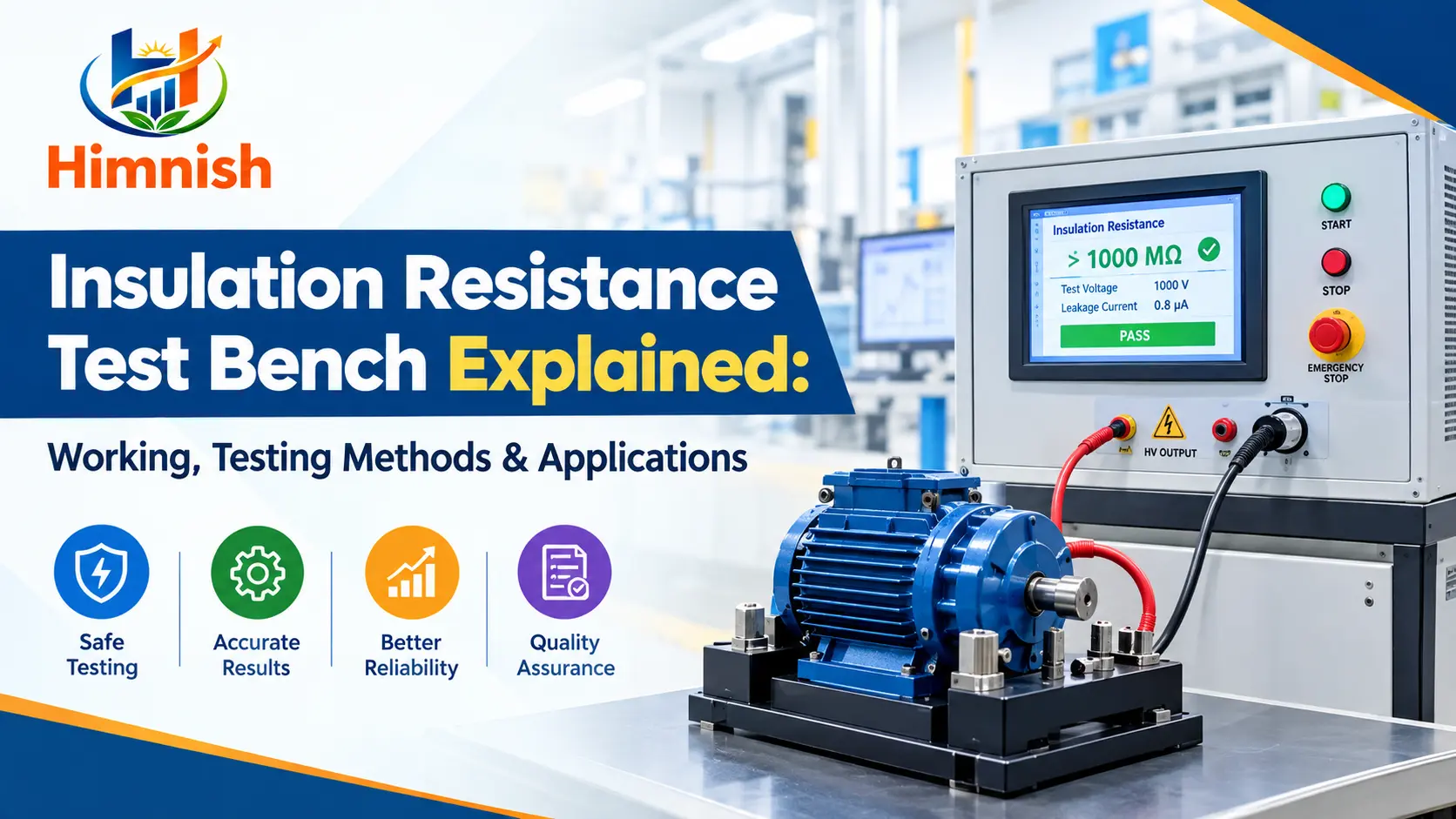
The bench generally consists of a testing fixture, electrical connections, a high-resistance measuring instrument, safety enclosure or guarding, controls, and sometimes automated data-acquisition software. The exact configuration depends on the product being tested.
The main objective is to provide a consistent environment where manufacturers can perform insulation resistance testing under defined test conditions.
Products such as motors, transformers, cables, wires, electrical assemblies, coils, switchgear, connectors, and other components can require insulation testing during manufacturing or maintenance.
Also Read: Pump Monitoring Systems: Working, Benefits & Applications
What Is Insulation Resistance?
Insulation resistance refers to the resistance that an insulating material provides against the flow of electrical current. Ideally, good insulation should allow very little leakage current.
The measurement is generally expressed in ohms, commonly using megohms (MΩ) or higher units because insulation resistance can be extremely high.
A low or decreasing insulation resistance value may indicate moisture, contamination, insulation deterioration, physical damage, or another electrical issue. However, acceptable values depend on the specific equipment, test voltage, applicable standards, and manufacturer’s requirements.
How Does an Insulation Resistance Test Bench Work?
The basic principle behind an insulation resistance test bench is straightforward.
The component under test is securely positioned on the fixture. The test instrument applies a predetermined DC voltage between selected conductive and insulating points. A very small leakage current may flow through or across the insulation.
The test equipment measures this current and determines the resistance using the relationship between applied voltage and leakage current.
In simplified form:
Insulation Resistance = Test Voltage ÷ Leakage Current
For example, if the applied test voltage remains constant while leakage current increases, the calculated insulation resistance decreases.
Modern systems can automatically record the measured value and display whether the test result falls within the predefined acceptance range.
Insulation Resistance Testing Process
A typical test sequence involves several important steps.
1. Preparing the Test Sample
The component should be clean, dry, and correctly positioned. Its electrical connections must be identified before testing.
2. Connecting the Test Leads
The test leads are connected between the appropriate conductive parts and the insulation reference point, depending on the application.
3. Selecting Test Parameters
The operator selects the required test voltage and test duration according to the product specification or applicable testing procedure.
4. Applying the Test Voltage
The insulation resistance tester applies the selected DC voltage to the test object.
5. Measuring Leakage Current
The instrument monitors the resulting leakage current and calculates the insulation resistance measurement.
6. Recording the Result
The final value can be displayed on the instrument or transferred to a computer or production database in an automated test system.
7. Discharging the Test Object
After the test, the component may retain electrical charge. Proper discharge is therefore an important part of the testing sequence before the sample is handled.
Insulation Testing vs Insulation Resistance Testing
The terms insulation testing and insulation resistance testing are sometimes used interchangeably, but insulation testing is a broader term.
Insulation testing can involve different methods depending on what needs to be evaluated. Insulation resistance measurement specifically determines the resistance of the insulation against leakage current under a defined test voltage.
Other electrical tests may evaluate dielectric withstand, breakdown behavior, polarization characteristics, or other properties.
Therefore, the appropriate test method should be selected according to the equipment design and testing requirements.
What Is IR Testing?
IR testing, or insulation resistance testing, is a widely used electrical diagnostic method for evaluating insulation condition.
It can be performed during manufacturing, commissioning, routine maintenance, troubleshooting, and preventive maintenance programs.
For production environments, an IR test bench can make testing more repeatable by keeping the test fixture, connections, operating procedure, and safety arrangements consistent from one test cycle to another.
Importance of Insulation Resistance Measurement
Reliable insulation resistance measurement provides valuable information about the condition of electrical insulation.
One of its major benefits is early identification of potential insulation problems. If measurements show an unusual reduction compared with previous results or expected values, maintenance personnel can investigate the equipment before a more serious electrical fault develops.
Insulation resistance data can also support quality control. Manufacturers can establish acceptance criteria and test every unit or selected samples according to their quality procedures.
For maintenance teams, recording historical measurements can be particularly useful because trends may reveal gradual insulation deterioration that a single measurement cannot show.
Major Components of an Insulation Resistance Test Bench
The configuration of a test bench varies according to the application, but common components include:
- Insulation resistance tester: Provides the test voltage and measures insulation resistance.
- Test fixture: Holds the component securely and provides repeatable electrical connections.
- Control panel: Allows the operator to initiate and manage the test.
- Safety enclosure: Helps prevent accidental contact with energized test points.
- Interlock system: Prevents testing when safety conditions are not satisfied.
- Data acquisition system: Records measurements for quality and traceability.
- PC or HMI: May provide test-result visualization and reporting.
- Discharge circuit: Helps safely remove residual electrical charge after testing.
Benefits of Using an Insulation Resistance Test Bench
A dedicated test bench can provide several practical advantages.
Consistent Testing
A fixed fixture and defined procedure help reduce variations caused by manual testing arrangements.
Improved Safety
Proper guarding, interlocks, grounding, and controlled test sequences can make high-voltage testing more organized and safer when implemented correctly.
Faster Quality Inspection
Automated test sequences can reduce the time required to perform repetitive measurements in production environments.
Better Data Management
Digital systems can store test values, product identification, timestamps, and pass/fail results for future reference.
Early Fault Detection
Insulation problems can be identified before they result in leakage, short circuits, equipment damage, or unexpected downtime.
Production Traceability
Manufacturers can associate test results with individual products or batches, helping support quality-control and traceability requirements.
Applications of Insulation Resistance Test Benches
Insulation resistance test benches are useful across many electrical and industrial applications.
Motors and Generators
Motor windings and generator insulation can be evaluated to identify possible deterioration or contamination.
Transformers
Insulation between windings and other conductive parts can be checked as part of testing and maintenance procedures.
Cables and Wires
Manufacturers can use controlled testing setups to verify insulation performance during production.
Electrical Panels and Assemblies
Electrical assemblies can undergo insulation checks before being supplied or commissioned.
Coils and Windings
Specialized fixtures can be designed for testing coils used in motors, transformers, solenoids, and other electrical equipment.
Electrical Components
Connectors, terminals, harnesses, switches, and other components can also require insulation evaluation depending on their design and application.
Best Practices for Reliable IR Testing
Accurate results depend not only on the test instrument but also on the testing environment. Before performing an insulation test, ensure that the sample is isolated from external power sources and that the correct test connections are used. Environmental factors such as temperature, humidity, surface contamination, and moisture can influence measurements.
The same test conditions should be maintained when comparing historical readings. Operators should also follow the equipment manufacturer’s instructions and applicable electrical safety procedures.
Conclusion
An Insulation Resistance Test Bench provides a structured and controlled way to evaluate the condition and quality of electrical insulation. By combining a suitable insulation resistance tester, reliable fixtures, safety systems, and data-recording capabilities, manufacturers can perform repeatable testing across a wide range of electrical products.
From motors and transformers to cables, coils, and electrical assemblies, insulation resistance testing can help identify potential insulation problems and support quality assurance and preventive maintenance.
With the growing focus on electrical reliability, automation, and traceable quality control, properly designed IR testing systems can become an important part of modern industrial testing processes. Himnish Limited can support industries looking for organized and application-focused testing solutions designed around their specific electrical testing requirements.