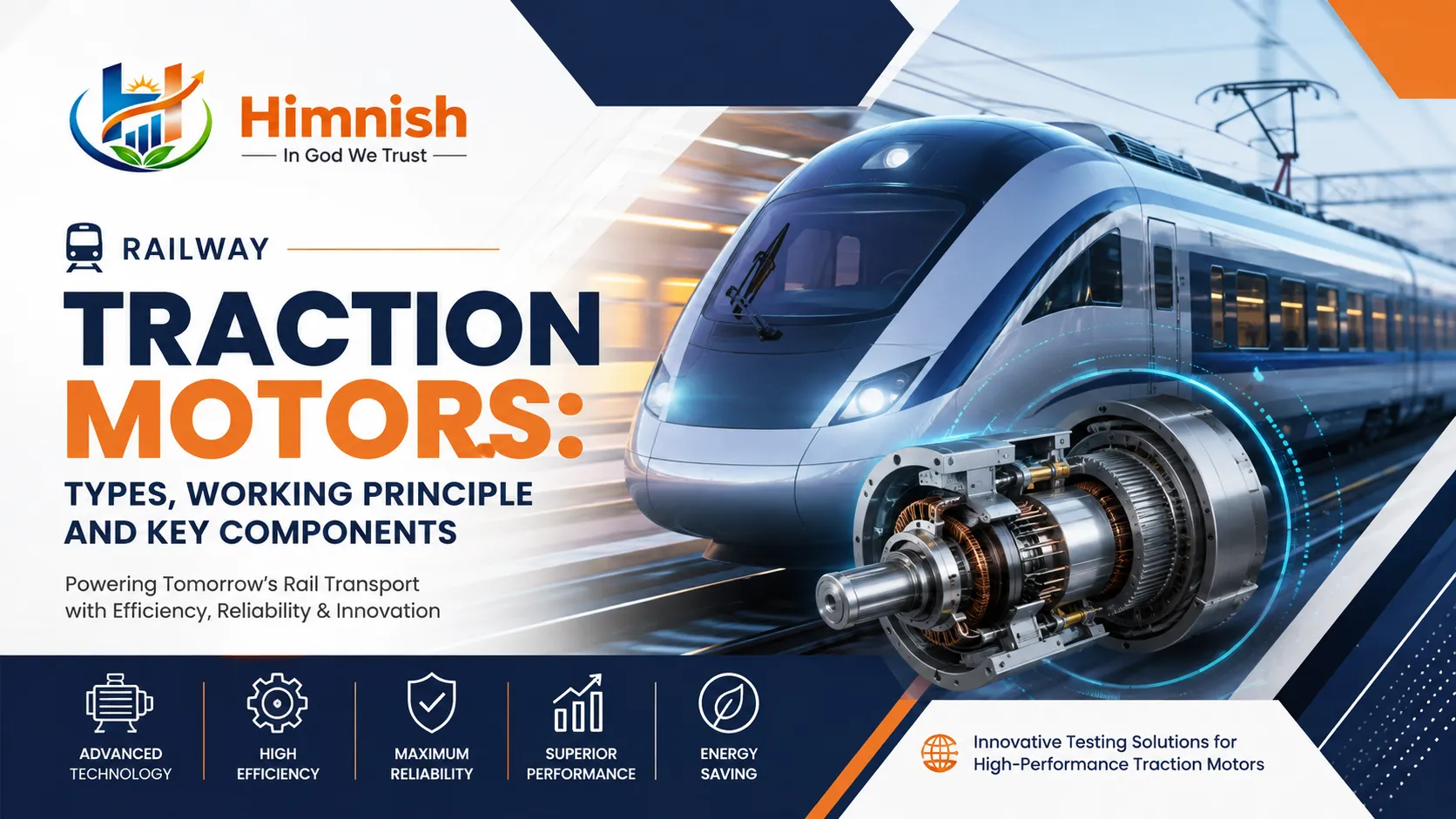
The railway industry has evolved significantly over the past few decades, driven by the need for faster transportation, improved energy efficiency, and enhanced passenger safety. At the heart of every modern electric train, metro, locomotive, and high-speed rail system lies one of the most critical components—the traction motor. It is the traction motor that converts electrical energy into mechanical power, enabling trains to move smoothly, accelerate efficiently, and carry heavy loads over long distances.
As railway systems continue to adopt advanced technologies, the demand for high-performance traction motors has increased dramatically. To ensure these motors operate reliably under demanding conditions, manufacturers and maintenance facilities rely on advanced testing solutions to verify their performance before installation and during servicing.
In this blog, we’ll explore Railway Traction Motors: Types, Working Principle and Key Components, helping you understand how these motors work, their different types, and why proper testing is essential for railway safety and operational efficiency.
What is a Railway Traction Motor?
A railway traction motor is a specially designed electric motor used to drive the wheels of electric trains, locomotives, metro coaches, and other rail vehicles. Unlike standard industrial motors, traction motors are built to withstand continuous operation, high torque demands, varying speeds, vibrations, and harsh environmental conditions.
The primary function of a traction motor is to convert electrical energy supplied from the overhead catenary system, third rail, or onboard power source into mechanical energy. This mechanical power is then transmitted to the wheels through a gearbox or direct drive mechanism, allowing the train to move.
Modern railway traction motors are designed to deliver high starting torque, smooth acceleration, efficient braking, and reliable performance while minimizing energy consumption. Their durability and efficiency make them indispensable for today’s railway transportation systems.
Also Read: What is a Motor Test Bench? Types, Working & Applications
Why are Railway Traction Motors Important?
Railway operations demand exceptional reliability because even a small motor failure can disrupt train schedules, increase maintenance costs, and compromise passenger safety. Traction motors are responsible for delivering consistent power throughout every stage of train operation, from starting and acceleration to cruising and braking.
A high-quality traction motor improves energy efficiency, reduces operational costs, and enhances passenger comfort by ensuring smooth movement with minimal vibration and noise. Additionally, advanced traction motors support regenerative braking systems, allowing energy generated during braking to be fed back into the electrical network, making railway transportation more sustainable.
As railway networks continue to expand worldwide, reliable traction motors remain one of the most important technologies supporting safe and efficient rail transport.
Traction Motor Working Principle
Understanding the traction motor working principle helps explain why these motors are capable of handling heavy loads while maintaining precise speed control. The process begins when electrical power is supplied to the traction motor from the train’s power source. This electrical energy creates a magnetic field inside the motor. The interaction between the magnetic field and the motor’s rotor generates rotational force, commonly known as torque.
This torque is transmitted through the gearbox to the train’s wheels, causing the vehicle to move forward. During acceleration, the motor delivers high torque to overcome inertia. As the train reaches cruising speed, the motor adjusts its output to maintain efficient operation while consuming less power.
Modern traction motors work in conjunction with sophisticated electronic control systems that continuously monitor speed, temperature, current, and load conditions. These control systems optimize performance while protecting the motor from overload, overheating, and excessive wear. The traction motor working principle also supports regenerative braking, where the motor temporarily acts as a generator during deceleration, converting kinetic energy back into electrical energy for improved efficiency.
Traction Motor Types
Different railway applications require different motor technologies. The selection depends on speed requirements, maintenance needs, energy efficiency, and operational conditions. Some of the most widely used traction motor types include:
- DC Traction Motors – Traditionally used in older locomotives due to their excellent starting torque and simple speed control.
- AC Induction Traction Motors – The most common choice for modern electric locomotives and metro trains because of their reliability, low maintenance, and high efficiency.
- Permanent Magnet Synchronous Motors (PMSM) – Offer superior efficiency, compact size, and reduced energy consumption, making them increasingly popular in high-speed rail applications.
- Brushless Traction Motors – Designed for long service life with minimal maintenance requirements by eliminating carbon brushes.
- Synchronous Traction Motors – Used in specialized railway systems where precise speed control and high efficiency are required.
Among all traction motor types, AC induction motors have become the industry standard due to their durability, excellent performance, and compatibility with modern inverter-based control systems.
Key Components of Railway Traction Motors
The performance and reliability of a traction motor depend on the quality of its individual components. Each part plays a specific role in ensuring smooth and efficient operation.
Some of the key components include:
- Stator – Produces the magnetic field required for motor operation.
- Rotor – Rotates inside the stator and generates mechanical power.
- Shaft – Transfers rotational energy to the gearbox or wheel assembly.
- Bearings – Support smooth shaft rotation while reducing friction.
- Cooling System – Maintains optimum operating temperature and prevents overheating.
- Insulation System – Protects electrical windings from short circuits and electrical failures.
- Motor Housing – Provides structural strength and safeguards internal components from dust, moisture, and vibration.
- Sensors and Monitoring Devices – Continuously monitor temperature, vibration, and motor performance for predictive maintenance.
The reliability of these components directly affects the lifespan and efficiency of railway traction motors.
Applications of Railway Traction Motors
Today, traction motors are used across various railway transportation systems worldwide. Their ability to deliver high torque and reliable performance makes them suitable for both passenger and freight operations.
They are commonly used in:
- Electric locomotives
- Metro rail systems
- High-speed trains
- Electric Multiple Units (EMUs)
- Diesel-electric locomotives
- Light rail transit systems
- Industrial railway vehicles
- Mining rail transport equipment
As railway infrastructure continues to modernize, the role of advanced traction motors becomes even more significant.
Why Testing Railway Traction Motors is Essential
Railway traction motors operate under continuous mechanical stress, electrical loading, and changing environmental conditions. Without proper testing, hidden defects may lead to unexpected failures and costly downtime.
Comprehensive testing helps manufacturers and maintenance teams evaluate motor performance, identify insulation issues, monitor vibration levels, and verify efficiency before installation.
Routine testing offers several important benefits:
- Improves operational reliability
- Detects faults before failure
- Reduces maintenance costs
- Enhances passenger safety
- Increases motor lifespan
- Supports predictive maintenance programs
- Ensures compliance with railway quality standards
Advanced motor testing systems provide accurate data that helps railway operators maintain consistent fleet performance.
How Himnish Projects Supports Railway Motor Testing
As railway technology becomes increasingly sophisticated, testing solutions must also evolve. Himnish Projects provides advanced motor testing and automation solutions designed to meet the demanding requirements of railway and industrial applications.
Our customized testing systems are engineered to evaluate the performance, efficiency, and reliability of traction motors with exceptional accuracy. Equipped with intelligent software, precision sensors, and automated reporting capabilities, our solutions help manufacturers and maintenance facilities improve quality control while reducing inspection time.
Whether you require testing for new traction motors or routine maintenance of existing railway equipment, Himnish Projects delivers reliable solutions tailored to your operational needs. Our commitment to innovation, technical excellence, and dependable after-sales support makes us a trusted partner for advanced motor testing applications.
Conclusion
Railway transportation depends on reliable, efficient, and durable traction motors to ensure smooth and safe operations. Understanding Railway Traction Motors: Types, Working Principle and Key Components provides valuable insight into how these powerful machines convert electrical energy into motion while supporting modern railway infrastructure.
From understanding the traction motor working principle to exploring different traction motor types, it is clear that these motors play a vital role in improving energy efficiency, reducing maintenance costs, and enhancing operational reliability. With advanced testing solutions from Himnish Projects, railway manufacturers and maintenance organizations can ensure every traction motor delivers optimal performance throughout its service life.
Frequently Asked Questions (FAQs)
1. What is a railway traction motor?
A railway traction motor is an electric motor that converts electrical energy into mechanical power to drive the wheels of locomotives, metro trains, and other railway vehicles.
2. What is the traction motor working principle?
The traction motor working principle involves converting electrical energy into rotational torque through electromagnetic interaction, which is then transmitted to the train’s wheels.
3. What are the main traction motor types?
The most common traction motor types include DC traction motors, AC induction motors, permanent magnet synchronous motors (PMSM), brushless motors, and synchronous traction motors.
4. Why is testing traction motors important?
Testing helps detect defects, improve reliability, enhance safety, reduce maintenance costs, and ensure compliance with railway quality standards.
5. Why choose Himnish Projects for traction motor testing solutions?
Himnish Projects offers advanced, customized motor testing systems with precision measurement, intelligent automation, real-time monitoring, and dependable technical support to ensure reliable traction motor performance.