Nitrogen is an essential industrial gas used across manufacturing, food processing, pharmaceuticals, electronics, chemicals, metal processing, and many other industries. Traditionally, businesses have depended on nitrogen cylinders or bulk liquid nitrogen supplied by third parties. However, these options can involve recurring transportation costs, storage requirements, supply dependency, and handling challenges.
A more practical solution for many industries is PSA nitrogen generation. This technology allows businesses to produce high-purity nitrogen directly at their facility from compressed air. But how does it work, and why is it becoming increasingly popular?
In this guide, we will explain the PSA nitrogen generator working principle, major benefits, applications, and important considerations when selecting a nitrogen generation system.
What Is PSA Nitrogen Generation?
PSA stands for Pressure Swing Adsorption, a gas separation technology used to produce nitrogen from compressed atmospheric air. In a typical system, compressed air contains approximately 78% nitrogen, along with oxygen, carbon dioxide, water vapour, and other gases.
A pressure swing adsorption nitrogen system separates nitrogen from these other components by using a special adsorbent material, commonly carbon molecular sieve (CMS).
During operation, oxygen and other unwanted gases are preferentially adsorbed by the CMS, while nitrogen passes through as the product gas. By periodically changing the pressure inside the adsorption vessels, the adsorbent is regenerated and prepared for the next cycle.
This continuous process makes a pressure swing adsorption nitrogen generator a convenient on-site nitrogen source for industries requiring a reliable and controlled supply.
Also Read: What Is an Industrial Test Bench and How Does It Work?
PSA Nitrogen Generator Working Principle
Understanding the PSA nitrogen generator working principle becomes easier when the process is divided into a few basic stages.
1. Compressed Air Supply
The process begins with atmospheric air. An air compressor supplies compressed air to the nitrogen generation system. Before entering the adsorption vessels, the compressed air generally passes through filtration and air-treatment equipment. These components help remove oil, moisture, dust, and other contaminants that could affect the adsorbent material.
2. Air Filtration and Conditioning
Proper air preparation is important for maintaining the performance and service life of the system. Filters and dryers can remove contaminants and excess moisture from compressed air. Clean and properly conditioned air then enters the PSA unit.
3. Adsorption Process
The treated compressed air enters one of the adsorption vessels containing carbon molecular sieve. The CMS selectively adsorbs oxygen, carbon dioxide, and other gases while allowing nitrogen to pass through. The nitrogen-rich gas is collected as the product gas. This is the core of nitrogen pressure swing adsorption technology.
4. Pressure Reduction and Regeneration
Once the adsorption vessel reaches its operating capacity, it must be regenerated. The pressure is reduced, allowing the adsorbed oxygen and other gases to be released from the CMS. The vessel is then ready for another adsorption cycle.
5. Continuous Nitrogen Production
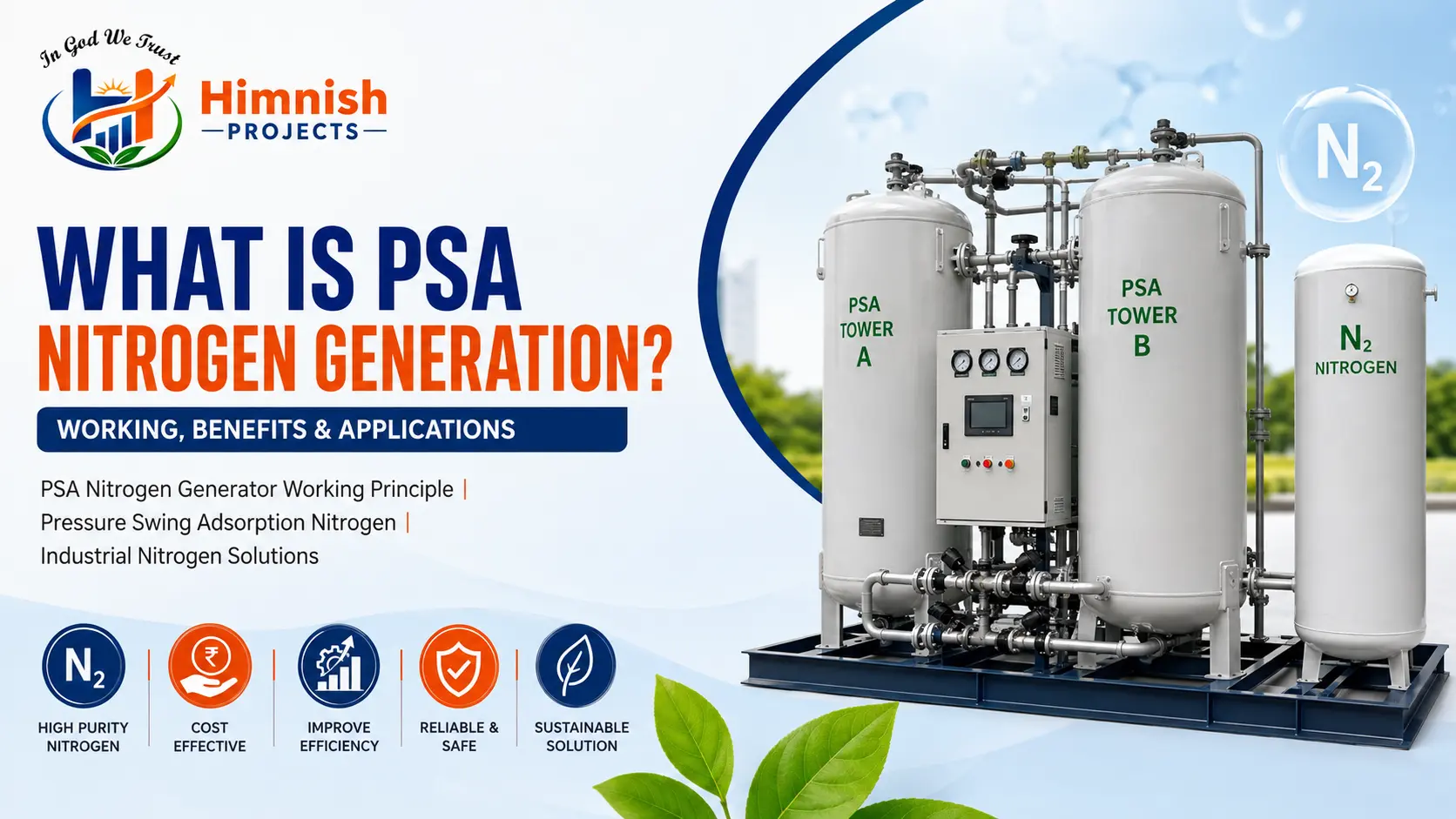
A PSA system normally uses at least two adsorption vessels. While one vessel produces nitrogen, the other is undergoing regeneration. The vessels alternate between adsorption and regeneration, allowing the PSA nitrogen gas generator to provide a continuous nitrogen supply.
Main Components of a PSA Nitrogen Generator
A complete PSA nitrogen generation system can include several components working together to provide consistent gas quality and flow.
Common components include:
- Air compressor
- Air receiver tank
- Pre-filters and fine filters
- Air dryer
- PSA adsorption vessels
- Carbon molecular sieve
- Nitrogen receiver
- Automatic valves
- Pressure regulators
- Control panel
- Nitrogen purity monitoring system
- Flow and pressure instruments
The exact configuration depends on the required nitrogen purity, flow rate, operating pressure, and application.
Benefits of PSA Nitrogen Generation
Businesses choose PSA technology because it can provide several operational and economic advantages.
On-Site Nitrogen Production
One of the biggest advantages is the ability to generate nitrogen at the point of use. Companies do not have to depend entirely on frequent cylinder deliveries or bulk nitrogen transportation.
Reduced Gas Supply Costs
For facilities with continuous nitrogen demand, producing nitrogen on-site can reduce dependence on externally supplied gas. The overall operating economics depend on electricity consumption, nitrogen demand, purity, compressor efficiency, and system configuration.
Continuous and Reliable Supply
A properly designed PSA system can operate continuously and provide nitrogen according to production requirements. This can be particularly valuable for industrial processes where an uninterrupted gas supply is important.
Adjustable Nitrogen Purity
PSA technology can be configured for different nitrogen purity requirements. The required purity depends on the application. Higher purity generally requires greater system capacity or additional process optimization.
Easy Integration
A PSA nitrogen generator can be integrated with existing compressed-air systems and connected directly to production equipment, storage tanks, pipelines, and other process systems.
Reduced Cylinder Handling
Producing nitrogen on-site can minimize the need to handle, store, and replace large numbers of nitrogen cylinders. This can also simplify gas logistics within an industrial facility.
Scalable Solution
PSA systems can be designed according to nitrogen consumption requirements. Businesses can select an appropriately sized system based on present demand while considering future expansion.
Applications of PSA Nitrogen Generators
The versatility of PSA nitrogen generation makes it suitable for numerous industrial applications.
Food and Beverage Industry
Nitrogen is widely used for packaging and preservation. It can help reduce oxygen exposure and support product quality and shelf life in suitable packaging applications.
Pharmaceutical Manufacturing
Nitrogen can be used in pharmaceutical processes where an inert atmosphere is required. It may be used for blanketing, packaging, and protecting sensitive materials from oxygen and moisture.
Chemical Industry
Chemical plants use nitrogen for inerting, blanketing, purging, and preventing unwanted oxidation during various manufacturing and storage processes.
Metal Processing
Nitrogen can be used in heat treatment, furnace atmospheres, laser cutting, and other metal-processing applications where controlled gas environments are required.
Electronics Manufacturing
Electronics and semiconductor-related processes can require controlled atmospheres with low oxygen levels. Nitrogen can support processes where contamination and oxidation need to be minimized.
Oil and Gas Industry
Nitrogen is used for purging, inerting, pressure-related applications, and equipment protection in various oil and gas operations.
Laser Cutting
Nitrogen can serve as an assist gas in laser cutting applications, particularly when a clean cutting environment and reduced oxidation are desired.
PSA Nitrogen vs. Purchased Nitrogen
When choosing between an on-site nitrogen system and purchased nitrogen, businesses should evaluate their gas consumption, purity requirements, operating schedule, available utilities, and logistics.
Purchased nitrogen may be convenient for smaller or occasional requirements. However, facilities with consistent and higher nitrogen consumption may find an on-site pressure swing adsorption nitrogen generator more practical.
An on-site system provides greater control over nitrogen production and reduces reliance on external deliveries. The right option ultimately depends on the facility’s specific operating requirements and financial analysis.
Factors to Consider When Selecting a PSA Nitrogen Generator
Before installing a PSA nitrogen generator, businesses should carefully evaluate several technical parameters.
- Nitrogen purity: Determine the purity level required by the application.
- Nitrogen flow rate: Calculate peak and average nitrogen consumption.
- Operating pressure: Identify the pressure required at the point of use.
- Compressed-air quality: Ensure the compressor and air-treatment system can provide suitable feed air.
- Operating hours: Continuous production may require a different configuration from intermittent operation.
- Future expansion: Consider expected increases in nitrogen demand.
- Energy efficiency: Compressor performance and system design can significantly influence operating costs.
Working with an experienced nitrogen generation system provider can help ensure that the equipment is correctly sized and configured.
Why Choose PSA Nitrogen Generation for Industrial Use?
The main attraction of PSA technology is its ability to transform readily available compressed air into a controlled supply of nitrogen. Instead of depending entirely on external gas deliveries, industries can produce nitrogen according to their operational requirements.
With proper sizing, filtration, maintenance, and monitoring, a PSA nitrogen gas generator can become an important part of an industrial utility system.
Conclusion
PSA nitrogen generation is a proven technology for producing nitrogen directly from compressed air. Using carbon molecular sieve and alternating adsorption and regeneration cycles, a PSA system separates nitrogen from oxygen and other components of air.
From food packaging and pharmaceuticals to chemical processing, metal treatment, electronics, and laser cutting, the technology has a wide range of industrial applications.
For businesses looking for a dependable on-site nitrogen source, understanding the PSA nitrogen generator working principle, purity requirements, flow demand, and operating conditions is essential. With the right system design, PSA technology can provide a practical, flexible, and reliable approach to industrial nitrogen supply.