
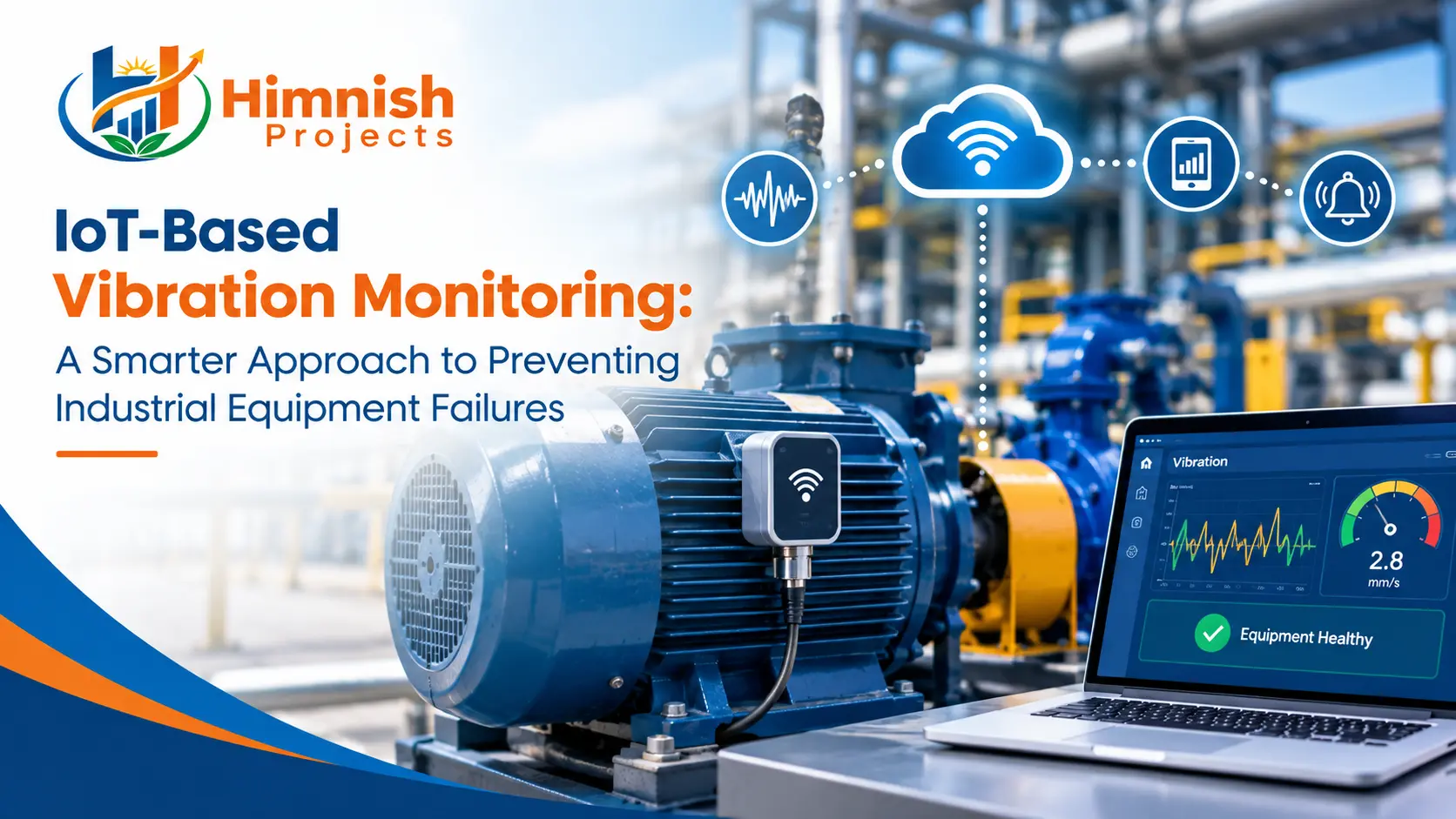
Industrial equipment often gives early warning signs before a serious breakdown occurs. One of the most useful warning signs is abnormal vibration. Changes in vibration can indicate problems such as bearing wear, shaft misalignment, imbalance, looseness, or other mechanical issues. By identifying these changes early, industries can take corrective action before a minor fault develops into an expensive equipment failure.
This is where IoT-Based Vibration Monitoring: A Smarter Approach to Preventing Industrial Equipment Failures becomes important. By combining vibration sensors with IoT connectivity, industries can continuously monitor machine health, collect operating data, and identify developing problems without relying only on periodic manual inspections.
What Is IoT-Based Vibration Monitoring?
IoT-based vibration monitoring is a condition-monitoring approach that uses sensors to measure vibrations produced by industrial machines. The collected information can be transmitted through an IoT network to a monitoring platform, where it can be analyzed to understand the condition of the equipment.
Traditional vibration checks may require technicians to inspect machines at scheduled intervals. Although useful, periodic inspection may not detect a problem that develops between two inspection cycles. An IoT-enabled system can provide continuous or scheduled monitoring, helping maintenance teams obtain a more complete picture of machine health.
An iot vibration sensor can measure parameters associated with machine vibration and send the data to a connected monitoring system. Depending on the application, the system may also monitor temperature and other operating parameters.
Also Read: What Is PSA Nitrogen Generation? Working, Benefits & Applications
How Does an IoT Vibration Monitoring System Work?
The process starts with installing vibration sensors at suitable points on industrial equipment. Common monitoring locations include motor housings, pumps, fans, gearboxes, compressors, and bearing assemblies.
The sensor collects vibration data while the machine is operating. This information is then transmitted to an IoT gateway or communication network. The data can be displayed on a centralized dashboard, allowing maintenance teams to monitor equipment remotely.
When vibration levels or patterns move outside expected operating conditions, the system can generate an alert. Maintenance personnel can then inspect the equipment and determine whether corrective action is required.
This approach changes maintenance from simply reacting to breakdowns to proactively identifying potential problems.
Role of an IoT Vibration Sensor
An iot vibration sensor is an important component of a connected condition-monitoring system. It helps capture vibration information from rotating and other mechanical equipment.
The sensor can be installed on machines where vibration changes may indicate developing faults. Depending on the sensor and monitoring setup, collected data can help maintenance teams identify unusual operating patterns.
For example, increasing vibration around a motor or pump may encourage technicians to investigate possible imbalance, misalignment, looseness, or bearing-related issues. Early investigation can help reduce the risk of unexpected downtime.
Why Bearing Vibration Monitoring Matters
Bearings are critical components in many rotating machines. They support shafts and allow smooth rotation, but they can gradually deteriorate because of wear, lubrication problems, contamination, excessive loads, or operating conditions.
A bearing vibration sensor can be used to monitor vibration around bearing locations. Changes in vibration patterns can provide useful information about the condition of the bearing and surrounding mechanical components.
Early identification of abnormal vibration gives maintenance teams an opportunity to inspect lubrication, alignment, loading, mounting, and other possible causes. This can help prevent a damaged bearing from causing secondary damage to other machine components.
What Is an IoT Wireless Vibration Sensor?
Installing wired sensors throughout a large industrial facility can sometimes require additional cabling, installation work, and infrastructure. An iot wireless vibration sensor provides an alternative for applications where wireless communication is practical.
Wireless vibration sensors can transmit collected machine data to a suitable IoT gateway or monitoring platform. This can make monitoring more flexible, particularly when machines are located across different sections of a plant.
The choice between wired and wireless monitoring depends on factors such as machine location, communication range, environmental conditions, power availability, network infrastructure, and monitoring requirements.
Industrial Problems That Vibration Monitoring Can Help Identify
Vibration monitoring does not simply measure whether a machine is vibrating. The collected information can help identify changes associated with different mechanical conditions.
Common issues that may be investigated through vibration monitoring include:
- Bearing deterioration
- Shaft misalignment
- Mechanical imbalance
- Looseness
- Gear-related problems
- Coupling issues
- Lubrication-related problems
- Changes in machine operating condition
The actual diagnosis should be performed using appropriate measurements, analysis methods, machine specifications, and operating conditions. Vibration data is an important source of information, but it should be interpreted in the correct mechanical context.
Benefits of IoT-Based Vibration Monitoring
One of the biggest advantages of connected vibration monitoring is the ability to observe machine health without depending entirely on manual inspection.
Reduced Unexpected Downtime
Early alerts can help maintenance teams investigate developing issues before they result in a major breakdown. This can support better planning of maintenance activities.
Better Predictive Maintenance
Continuous equipment data can support predictive maintenance strategies. Instead of replacing components solely according to a fixed schedule, organizations can use machine-condition information to make more informed maintenance decisions.
Remote Monitoring
IoT connectivity allows machine information to be viewed through centralized dashboards or other monitoring platforms. This can be useful for facilities with multiple machines or distributed production areas.
Improved Maintenance Planning
When abnormal trends are detected early, maintenance teams may have more time to plan inspections, spare parts, manpower, and machine shutdowns.
Data-Driven Decisions
Historical vibration information can help organizations compare machine performance over time. This creates a useful record for understanding recurring problems and equipment behavior.
Applications of IoT Vibration Monitoring
IoT-based vibration monitoring can be applied across many industrial environments where rotating machinery plays an important role.
Typical applications include electric motors, pumps, fans, compressors, gearboxes, blowers, production machinery, and other rotating equipment.
Manufacturing plants, process industries, utilities, workshops, and other industrial facilities can use condition-monitoring systems to improve visibility into equipment performance. For machines that are critical to production, continuous condition monitoring can become an important part of an overall maintenance strategy.
IoT and the Future of Industrial Maintenance
Industrial maintenance is increasingly moving toward connected and data-driven systems. Instead of depending only on manual readings, organizations can combine sensors, communication networks, dashboards, analytics, and automated alerts.
IoT-based vibration monitoring fits naturally into this transition. Vibration data can become part of a broader equipment-monitoring system that includes parameters such as temperature, operating status, energy consumption, and other machine-specific information.
As industrial facilities adopt Industry 4.0 technologies, connected sensors can help create better visibility across production assets. This can support more informed maintenance decisions and improve the way equipment health is managed.
Choosing the Right Vibration Monitoring Solution
The right monitoring solution depends on the type of machinery, operating environment, required measurement parameters, installation location, communication requirements, and monitoring objectives.
Before selecting sensors, industries should consider whether wired or wireless monitoring is more suitable, where the sensors will be installed, how frequently data should be collected, and how alerts and historical information will be managed.
Sensor quality is also important. An iot vibration sensor, bearing vibration sensor, or iot wireless vibration sensor should be selected according to the specific machine and application rather than simply choosing equipment based on specifications alone.
Conclusion
IoT-Based Vibration Monitoring: A Smarter Approach to Preventing Industrial Equipment Failures offers industries a practical way to gain better visibility into machine health. By collecting vibration data and connecting it to an IoT-based monitoring platform, organizations can identify unusual machine behavior, support predictive maintenance, and plan corrective actions more effectively.
From motors and pumps to bearings, fans, compressors, and gearboxes, vibration monitoring can play an important role in modern industrial maintenance. As businesses continue adopting Industry 4.0 technologies, connected vibration monitoring can help create a more proactive, data-driven approach to equipment reliability and maintenance.