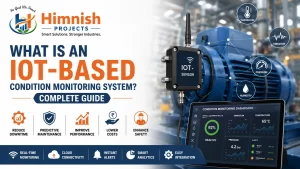
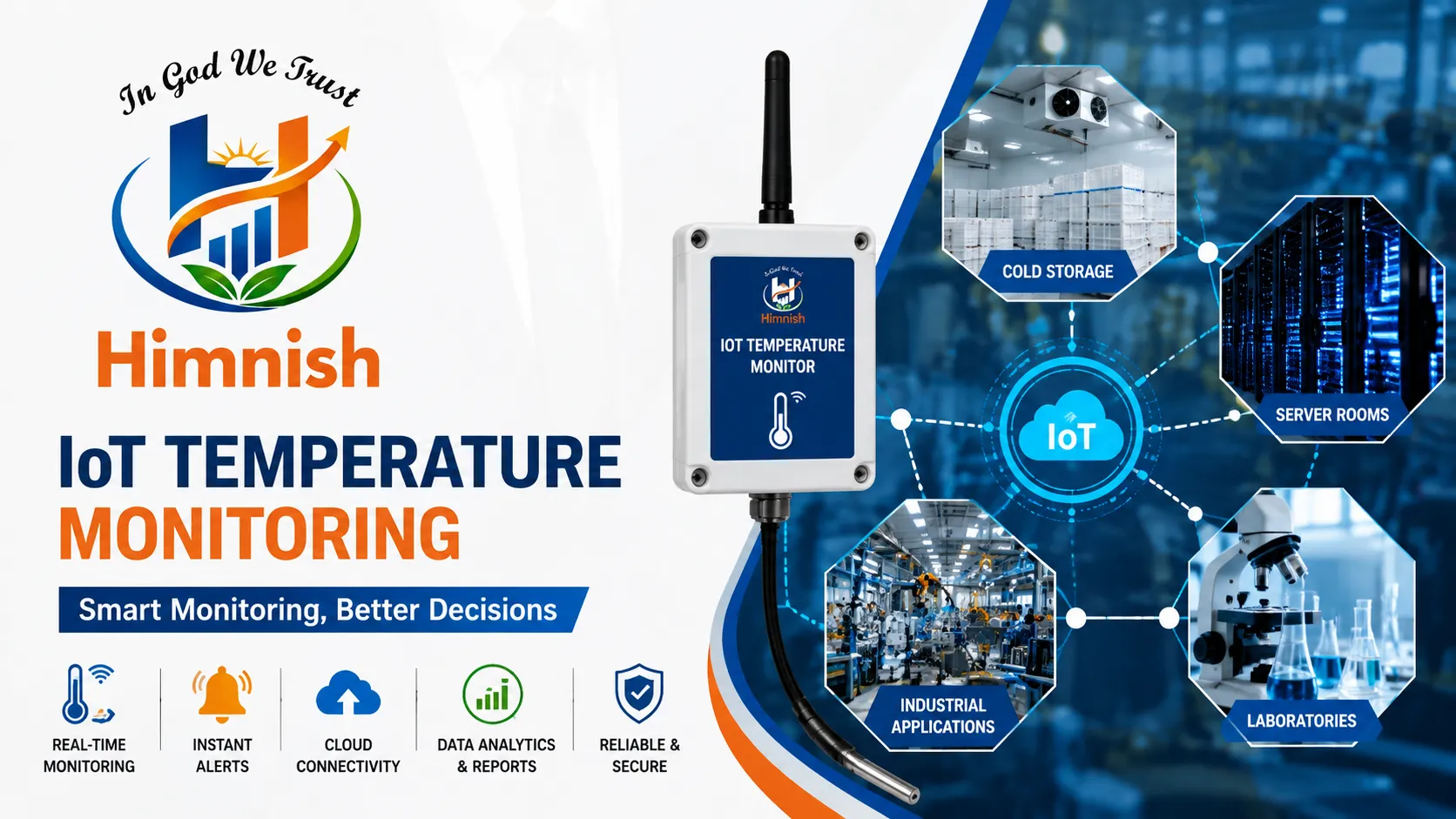
Temperature is one of the most important parameters to monitor in industrial facilities, data centers, warehouses, laboratories, server rooms, cold storage units, and many other environments. Even a small and unnoticed temperature change can affect equipment performance, product quality, energy consumption, and operational safety.
Traditional temperature monitoring often depends on manual readings or standalone sensors. While these methods can work for basic applications, they may not provide continuous visibility or instant alerts. IoT temperature monitoring offers a smarter approach by connecting temperature sensors to an internet-enabled system that can collect, transmit, analyze, and display temperature data in real time.
Himnish Limited focuses on smart monitoring and technology solutions that help businesses improve visibility over important operating conditions. In this guide, we will understand how IoT-based temperature monitoring works, its components, applications, benefits, and how it can be used for equipment and CPU temperature monitoring.
What Is IoT Temperature Monitoring?
IoT temperature monitoring is a technology-based system that uses connected temperature sensors to continuously measure temperature and transmit the collected information to a central platform, cloud application, dashboard, or monitoring device.
Instead of requiring an operator to physically check a thermometer, an IoT system can automatically collect temperature readings at predefined intervals. The data can then be viewed remotely through a computer, mobile device, or monitoring dashboard.
Depending on the system design, users can also receive alerts when the temperature goes above or below a predefined limit. This makes IoT monitoring particularly useful where maintaining a specific temperature range is important.
For example, a cold storage facility may need to maintain a controlled temperature for stored products. If the temperature rises unexpectedly, the system can generate an alert so that the responsible team can investigate the problem before significant damage occurs.
Also Read: PSA Oxygen Generation Plant: Working Principle & Applications
How Does IoT Temperature Monitoring Work?
The working principle of an IoT temperature monitoring system involves several connected components. First, a temperature sensor measures the surrounding temperature or the temperature of a specific piece of equipment. Depending on the application, different sensor technologies can be used.
The sensor sends the measurement to an IoT-enabled device or gateway. The gateway can process the information and transmit it through Wi-Fi, Ethernet, cellular networks, LoRaWAN, or another suitable communication technology.
The information is then sent to a monitoring platform where users can view current and historical temperature readings. The system may also store the data for analysis and reporting.
If the measured temperature crosses a predefined threshold, the monitoring platform can trigger an alert through available notification methods. This creates a continuous monitoring cycle without requiring personnel to manually record every temperature reading.
Main Components of an IoT Temperature Monitoring System
A typical system can contain several important components.
Temperature Sensors
The sensor is responsible for detecting temperature changes. The appropriate sensor depends on the required temperature range, accuracy, installation location, and environmental conditions.
IoT Gateway
A gateway connects sensors with the communication network or cloud platform. It can collect data from multiple sensors and transfer that information to the monitoring system.
Communication Network
IoT devices require a suitable communication method. Wi-Fi may be appropriate for buildings with reliable network coverage, while cellular or long-range wireless technologies can be useful for remote or large-scale installations.
Cloud or Monitoring Platform
The monitoring platform stores and displays temperature information. Depending on the system, users may be able to view live readings, historical trends, alarms, reports, and sensor status.
Dashboard
A dashboard gives users a convenient way to understand temperature conditions. Multiple sensors can often be displayed on one interface, making it easier to monitor different rooms, machines, or locations.
Why Is Continuous Temperature Monitoring Important?
Temperature can change because of equipment failure, power interruptions, ventilation problems, environmental conditions, refrigeration issues, or other unexpected events.
Manual inspection may not detect these changes immediately. By contrast, continuous monitoring can identify abnormal conditions as they occur.
For businesses, this can reduce response time. Instead of discovering a problem during the next scheduled inspection, operators can receive an alert and take corrective action sooner.
Continuous monitoring can also create a historical record. This information can be useful when investigating equipment problems, analyzing operating conditions, or demonstrating that a specific temperature range was maintained.
IoT Monitor CPU Temperature: How Does It Work?
IoT technology can also be used to monitor the temperature of computers, servers, industrial controllers, and other electronic equipment. When businesses search for iot monitor cpu temperature, they are generally looking for a way to collect processor temperature information and make that data available remotely.
A CPU temperature monitoring solution typically depends on temperature sensors already available within the computing hardware or additional external sensors where required. Monitoring software can collect temperature data and transmit it to a centralized platform.
This can be especially useful in server rooms and data centers where multiple computing systems operate continuously. If a processor begins operating at an unusually high temperature, the monitoring system can notify the responsible team. This gives technicians an opportunity to investigate cooling, airflow, workload, fan operation, or other potential causes.
Monitoring IoT Temperature in Industrial Applications
Monitoring IoT temperature is useful across a wide range of industrial environments. In manufacturing facilities, sensors can monitor equipment temperatures and help identify abnormal operating conditions. In warehouses, temperature sensors can help track environmental conditions in storage areas. In cold storage and refrigeration facilities, continuous monitoring can help verify that the required temperature range is being maintained.
Laboratories and pharmaceutical facilities can use connected temperature monitoring systems where controlled environmental conditions are important. HVAC systems can also benefit from temperature sensors installed at different locations to provide a broader view of building conditions.
Monitoring IoT CPU Temperature in Data Centers
Data centers are particularly sensitive to temperature because servers and networking equipment generate significant amounts of heat during operation. Monitoring IoT CPU temperature can provide additional visibility into individual computing systems or server environments.
When CPU temperatures increase significantly, the issue may be related to inadequate airflow, cooling-system performance, dust accumulation, high processing loads, fan problems, or other hardware conditions.
By collecting temperature information continuously, facility teams can identify unusual patterns instead of relying solely on occasional physical inspections.
CPU temperature data can also be analyzed alongside other parameters such as room temperature, humidity, power consumption, and equipment utilization to provide a more complete picture of system performance.
What Is an IoT CPU Temperature Monitor?
An IoT CPU temperature monitor is a connected monitoring solution that collects processor temperature information and makes it available through a remote monitoring interface.
Instead of checking individual computers manually, administrators can potentially monitor multiple systems from a centralized dashboard.
A well-designed system may allow users to define temperature thresholds and generate alerts when a CPU reaches an undesirable temperature.
For larger IT environments, this approach can make monitoring more organized and scalable. It can also help identify recurring thermal patterns that may otherwise be difficult to notice.
Benefits of IoT Temperature Monitoring
Real-Time Visibility
Users can view temperature readings remotely instead of depending entirely on manual measurements.
Instant Alerts
Temperature thresholds can be configured so that abnormal conditions generate notifications.
Historical Data
Recorded readings can help users understand temperature patterns over time.
Reduced Manual Monitoring
Automated data collection reduces the need for employees to repeatedly record readings.
Early Problem Detection
Unusual temperature changes can provide an early indication of equipment or environmental problems.
Better Decision-Making
Historical and real-time information can help maintenance teams make more informed decisions.
Scalable Monitoring
Multiple sensors can be connected to a centralized monitoring platform, making IoT suitable for facilities with numerous monitoring points.
Applications of IoT Temperature Monitoring
IoT-based temperature monitoring can be used in many industries, including:
- Data centers and server rooms
- Cold storage facilities
- Pharmaceutical storage
- Food processing and storage
- Warehouses
- Manufacturing plants
- Laboratories
- HVAC systems
- Industrial machinery
- Agriculture and controlled environments
- Electronics and equipment rooms
- Commercial buildings
The exact configuration should be selected according to the temperature range, sensor accuracy, communication distance, environmental conditions, and monitoring requirements.
How to Choose an IoT Temperature Monitoring System?
Before selecting a system, businesses should consider the required temperature range and measurement accuracy. Sensor placement is equally important because an incorrectly positioned sensor may not represent the actual condition being monitored.
Communication technology should be selected according to the facility layout and network availability. Battery life can also be important for wireless sensors installed in difficult-to-access locations.
The monitoring platform should provide an easy-to-understand dashboard, reliable alerts, data storage, and suitable reporting capabilities.
For CPU and server monitoring, compatibility with the hardware and monitoring software should also be considered.
Conclusion
IoT temperature monitoring provides businesses with a practical way to move from periodic manual temperature checks toward continuous, connected monitoring. By combining sensors, communication technology, gateways, and monitoring platforms, organizations can collect temperature information in real time and respond more quickly to abnormal conditions.
From industrial machinery and cold storage to server rooms and data centers, IoT technology can help improve visibility, reduce manual effort, and support preventive maintenance.
Solutions involving iot monitor cpu temperature, monitoring iot temperature, and monitoring iot cpu temperature can be particularly valuable when equipment or environmental temperature needs to be observed continuously. An iot cpu temperature monitor can further help IT teams keep track of thermal conditions across computing systems.
For businesses looking to implement connected monitoring, Himnish Limited can provide technology-focused solutions based on the specific requirements of the application. The right combination of sensors, connectivity, monitoring software, and alerts can turn temperature data into useful information for safer, more reliable, and more efficient operations.