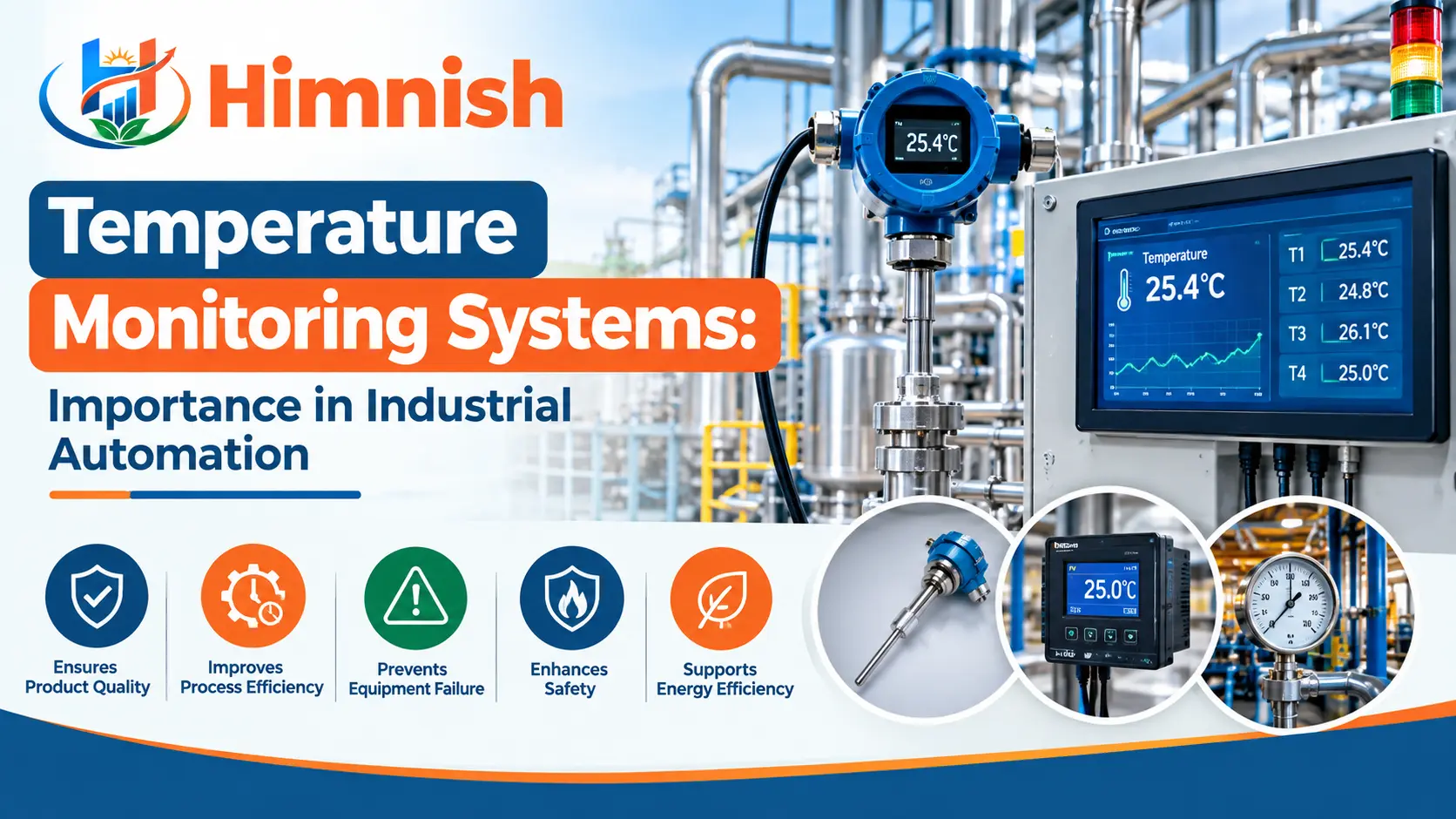
Temperature is one of the most important parameters to monitor in industrial environments. From manufacturing plants and warehouses to machinery rooms and processing facilities, maintaining the right temperature can directly affect equipment performance, product quality, safety, and operating costs. This is where temperature monitoring systems play an important role.
Modern industries are increasingly adopting automated monitoring solutions to collect temperature data continuously and identify abnormal conditions before they develop into serious problems. With real-time sensors, wireless connectivity, data logging, and automated alerts, businesses can improve process reliability while reducing the need for constant manual inspection.
For companies such as Himnish Projects, temperature monitoring solutions can be an important part of modern industrial automation and condition monitoring strategies.
What Is a Temperature Monitoring System?
A temperature monitoring system is a combination of sensors, communication devices, software, and monitoring equipment used to measure and track temperature continuously or at predefined intervals.
Unlike traditional temperature measurement methods that depend on manual readings, automated systems can collect temperature data in real time. The information can then be displayed on a dashboard, stored for analysis, or used to trigger alerts when the temperature crosses a predefined limit.
Depending on the application, these systems may use technologies such as RTD sensors, thermocouples, infrared sensors, wireless temperature sensors, data loggers, PLCs, or IoT-based monitoring devices.
Also Read: IoT-Based Vibration Monitoring: A Smarter Approach to Preventing Industrial Equipment Failures
Why Is Temperature Monitoring Important in Industrial Automation?
Industrial processes often operate within specific temperature ranges. Even a small deviation can affect machinery, materials, production quality, or workplace safety. Automated temperature monitoring helps industries maintain better control over these conditions.
Here are some of the major reasons why temperature monitoring is becoming an essential part of industrial automation.
1. Prevents Equipment Overheating
Industrial machinery generates heat during operation. Motors, bearings, gearboxes, compressors, electrical panels, and other components can become excessively hot due to friction, overload, poor lubrication, electrical faults, or cooling problems.
Continuous monitoring makes it possible to identify unusual temperature increases at an early stage. When the temperature reaches a defined threshold, the system can generate an alert, allowing maintenance teams to investigate the issue before major equipment damage occurs.
2. Supports Predictive Maintenance
Temperature is often an important indicator of equipment condition. A gradual or sudden rise in temperature can indicate developing mechanical or electrical problems.
By combining temperature sensors with industrial monitoring platforms, companies can observe temperature trends over time. This information can support predictive maintenance programs by helping maintenance teams identify abnormal operating patterns before equipment failure occurs.
Instead of relying only on fixed maintenance schedules, businesses can use actual equipment data to make better maintenance decisions.
3. Improves Process Control
Many industrial processes require precise temperature control. Manufacturing, chemical processing, food processing, pharmaceuticals, plastics, and other industries may depend on specific temperature ranges for consistent production.
A temperature monitoring system provides continuous information about process conditions. Automated control systems can use this data to activate cooling systems, heaters, fans, or other equipment when necessary.
This helps maintain stable operating conditions and reduces variations in the production process.
Role of Industrial Temperature Monitoring
Industrial temperature monitoring has become increasingly important as factories move toward connected and data-driven operations. Modern monitoring systems can connect temperature sensors with PLCs, SCADA systems, cloud platforms, or industrial IoT networks.
This allows operators to monitor multiple machines or locations from a centralized interface.
For example, temperature sensors installed on motors and bearings can continuously transmit readings to a monitoring platform. If the temperature rises beyond the configured limit, the system can send an alarm to the operator.
This approach reduces dependence on manual inspections and provides faster access to critical operating information.
Key Components of a Temperature Monitoring System
A typical temperature monitoring solution can include several components working together.
Temperature Sensors
Sensors are responsible for detecting temperature changes. RTDs, thermocouples, thermistors, and infrared sensors are commonly used depending on the operating environment and required measurement range.
Data Acquisition Unit
The data acquisition device receives signals from sensors and transfers the information to the monitoring or control system.
Communication Network
Depending on the application, communication may be wired or wireless. Industrial Ethernet, Modbus, Wi-Fi, LoRa-based communication, and other technologies can be used to transfer temperature data.
Monitoring Software
Monitoring software provides a visual interface where operators can view current temperature values, historical trends, alarms, and other relevant information.
Alarm and Notification System
When temperature exceeds a defined limit, the system can generate an alarm. Advanced solutions may also send notifications through connected communication platforms so that responsible personnel can respond quickly.
Benefits of Automated Temperature Monitoring
Automating temperature measurement offers several advantages for industrial facilities.
- Continuous monitoring: Temperature can be tracked around the clock without requiring employees to take manual readings.
- Early fault detection: Abnormal temperature patterns can indicate potential equipment problems before failure occurs.
- Reduced downtime: Early identification of overheating and other issues can help reduce unexpected equipment shutdowns.
- Better safety: Monitoring critical temperature conditions can help reduce risks associated with overheating and excessive heat.
- Improved efficiency: Automated systems reduce repetitive manual inspections and allow personnel to focus on more important maintenance activities.
- Historical data: Stored temperature information can be used to analyze trends, compare operating conditions, and support maintenance planning.
- Remote monitoring: Connected systems can allow authorized personnel to view temperature data from a centralized or remote location.
Applications of Temperature Monitoring Systems
Temperature monitoring can be used across a wide range of industrial applications.
Manufacturing Machinery
Motors, gearboxes, compressors, pumps, bearings, and production machinery can be monitored to identify abnormal heat generation.
Electrical Panels
Excessive heat in electrical panels, connections, and components may indicate electrical faults or overload conditions. Temperature monitoring can provide an additional layer of operational visibility.
Warehouses and Storage Areas
Temperature monitoring can help maintain suitable environmental conditions for sensitive materials, components, and products.
Process Industries
Industries that depend on controlled heating or cooling can use automated monitoring to maintain process consistency.
Industrial Equipment Rooms
Server rooms, control rooms, battery rooms, and equipment areas can also benefit from continuous temperature monitoring.
Temperature Monitoring and IoT-Based Automation
The integration of IoT technology has expanded the capabilities of temperature monitoring systems. IoT-enabled sensors can collect temperature information and transmit it to centralized platforms for analysis.
With historical data and real-time dashboards, industries can identify patterns such as gradual temperature increases, repeated overheating, or differences between machines operating under similar conditions.
When combined with other parameters such as vibration, pressure, humidity, and energy consumption, temperature data can contribute to a more comprehensive industrial condition monitoring strategy.
Choosing the Right Temperature Monitoring System
The right solution depends on several factors, including the operating temperature range, measurement accuracy, sensor location, environmental conditions, communication requirements, number of monitoring points, and integration with existing automation systems.
Industries should also consider whether they need local monitoring, remote access, automated alerts, data logging, or integration with PLC and SCADA systems.
A properly designed system should be reliable, scalable, and suitable for the specific industrial environment where it will be installed.
Conclusion
Temperature monitoring is no longer limited to checking readings manually at regular intervals. With modern automation, industries can continuously collect, analyze, and respond to temperature data in real time.
From preventing equipment overheating and supporting predictive maintenance to improving process control and workplace safety, temperature monitoring systems provide valuable operational information. The integration of sensors, communication technologies, automation platforms, and IoT solutions makes monitoring more efficient and responsive.
For modern industrial facilities, industrial temperature monitoring can become an important part of a broader automation and condition monitoring strategy. By adopting the right solution, businesses can gain better visibility into equipment conditions, respond to abnormal temperature changes faster, and work toward more reliable and efficient industrial operations.