In today’s competitive industrial environment, unplanned machine breakdowns can lead to costly production delays, expensive repairs, and reduced profitability. Traditional maintenance methods often rely on fixed schedules or repairing equipment after a failure occurs. While these approaches have been effective in the past, modern industries are now shifting towards smarter and more efficient maintenance strategies.
This is where IoT predictive maintenance comes into the picture. By combining smart sensors, cloud connectivity, and real-time data analytics, businesses can monitor equipment health continuously and predict failures before they happen.
In this comprehensive guide, we’ll explain What is IoT predictive maintenance?, how it works, its benefits, applications, and why businesses are increasingly adopting predictive maintenance using IoT to improve operational efficiency.
What is IoT Predictive Maintenance?
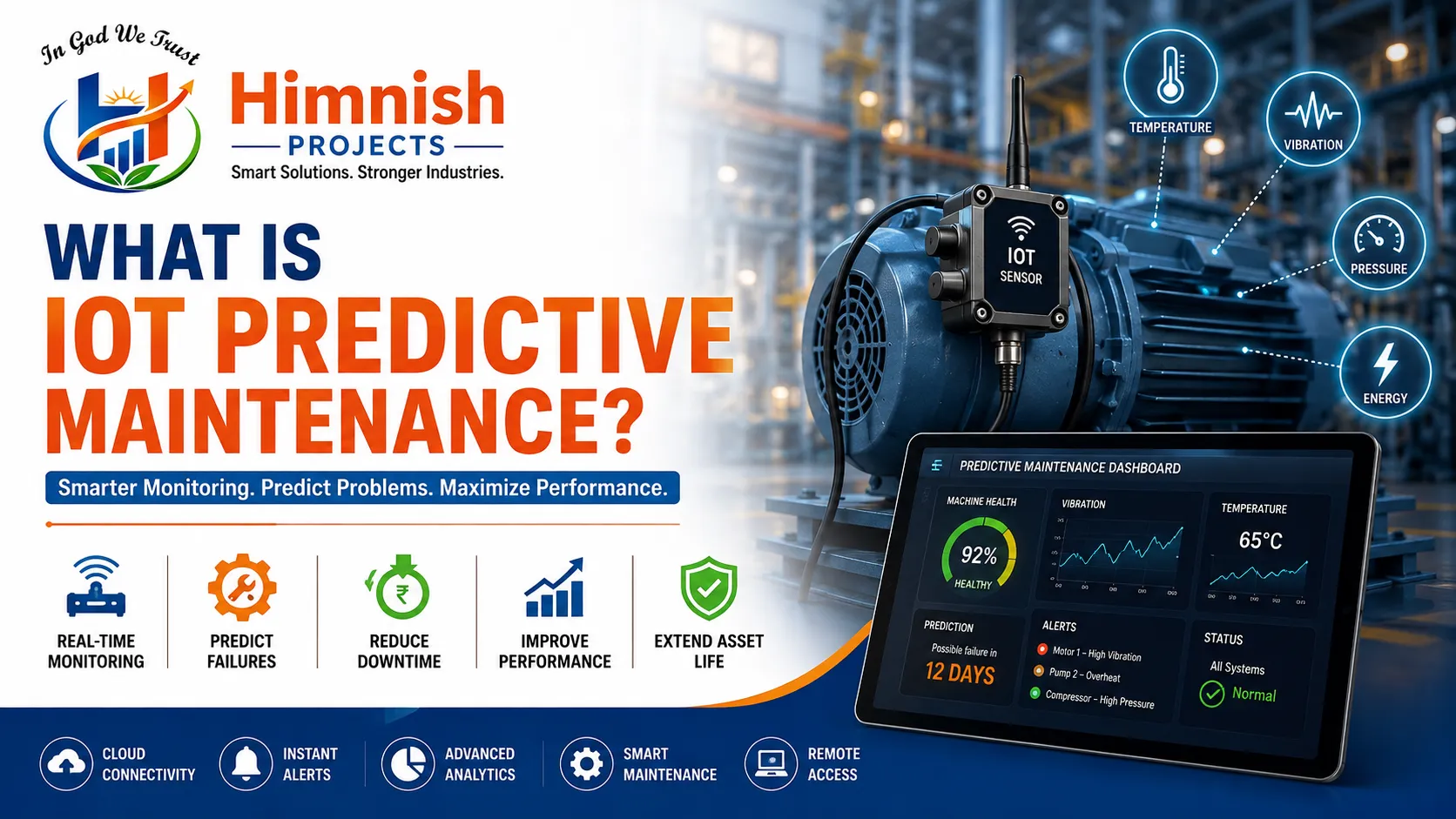
IoT predictive maintenance is an advanced maintenance strategy that uses Internet of Things (IoT) devices, sensors, cloud platforms, and data analytics to monitor the condition of industrial equipment in real time. Instead of waiting for a machine to fail or servicing it at fixed intervals, the system continuously analyzes machine performance and predicts when maintenance will actually be required.
The goal of predictive maintenance and IoT is simple—identify potential problems early, reduce unexpected downtime, and keep equipment operating at peak performance. This intelligent approach helps industries move from reactive maintenance to proactive decision-making, ultimately saving time and operational costs.
Also Read: What is an IoT-Based Condition Monitoring System? Complete Guide
How Does IoT Predictive Maintenance Work?
A predictive maintenance IoT system follows a structured process to monitor machine health.
1. Smart Sensor Installation
Industrial-grade IoT sensors are installed on critical equipment to monitor important operating parameters such as:
- Temperature
- Vibration
- Pressure
- Current
- Voltage
- Humidity
- Oil condition
- Motor speed
- Energy consumption
These sensors collect data continuously without interrupting operations.
2. Real-Time Data Collection
The sensors capture live operational data every second. This information provides a clear picture of equipment performance and health.
3. Cloud Connectivity
The collected data is securely transmitted through Wi-Fi, Ethernet, LoRaWAN, GSM, or NB-IoT to cloud platforms or local servers.
Cloud-based storage allows maintenance teams to monitor equipment remotely from any location.
4. Intelligent Data Analysis
Advanced software uses Artificial Intelligence (AI) and Machine Learning (ML) algorithms to analyze historical and real-time data. The system identifies abnormal trends before they develop into major equipment failures.
5. Maintenance Alerts
Whenever unusual conditions are detected, the system instantly sends notifications via:
- Mobile Apps
- SMS
- Industrial Dashboards
- SCADA Systems
Maintenance teams can schedule repairs before the equipment stops working.
Why is IoT Predictive Maintenance Important?
Traditional maintenance often results in unnecessary servicing or unexpected failures. IoT maintenance provides a smarter alternative by ensuring maintenance activities are performed only when required.
Key reasons industries prefer predictive maintenance using IoT include:
- Early fault detection
- Lower repair costs
- Increased machine reliability
- Improved productivity
- Better resource planning
- Enhanced workplace safety
Key Technologies Behind Predictive Maintenance Using IoT
Several advanced technologies work together to make predictive maintenance using IoT successful.
IoT Sensors
These sensors continuously monitor machine conditions.
Cloud Computing
Provides secure storage and easy access to operational data.
Artificial Intelligence (AI)
AI detects hidden fault patterns that may not be visible through manual inspections.
Machine Learning
Machine learning improves prediction accuracy by learning from historical equipment behavior.
Edge Computing
Processes data closer to the equipment for faster decision-making.
Data Analytics
Transforms raw sensor data into meaningful maintenance insights.
Benefits of IoT Predictive Maintenance
Reduced Unplanned Downtime
Unexpected equipment failures are minimized because problems are detected early.
Lower Maintenance Costs
Instead of replacing components unnecessarily, maintenance is carried out only when needed.
Increased Equipment Life
Machines operate within safe limits, reducing wear and extending operational lifespan.
Higher Productivity
Reliable equipment means fewer production interruptions and increased manufacturing efficiency.
Improved Safety
Potential equipment failures are identified before they create hazardous situations for workers.
Better Asset Management
Real-time monitoring allows businesses to optimize equipment usage and maintenance planning.
Improved Energy Efficiency
Faulty equipment often consumes more electricity. Continuous monitoring helps identify inefficient machines and reduce energy costs.
Data-Driven Decisions
Managers receive accurate reports and performance trends that support better operational planning.
Applications of Predictive Maintenance IoT
Today, predictive maintenance IoT solutions are widely used across various industries.
Manufacturing
Monitor motors, pumps, conveyors, compressors, and CNC machines.
Power Plants
Track turbines, generators, transformers, and electrical systems.
Oil & Gas
Monitor drilling equipment, compressors, storage tanks, and pipelines.
Water Treatment Plants
Ensure pumps, blowers, and filtration systems operate efficiently.
Mining Industry
Monitor heavy machinery operating under harsh conditions.
Cement Plants
Track rotating equipment, crushers, and mills.
Food Processing
Prevent equipment failures while maintaining production quality.
HVAC Systems
Monitor chillers, cooling towers, compressors, and ventilation equipment.
IoT Predictive Maintenance vs Preventive Maintenance
| Preventive Maintenance | IoT Predictive Maintenance |
|---|---|
| Fixed maintenance schedule | Maintenance based on machine condition |
| Higher maintenance cost | Optimized maintenance expenses |
| Manual inspections | Automated real-time monitoring |
| Unexpected failures may occur | Early fault prediction |
| Limited equipment visibility | Complete operational insights |
| More downtime | Minimal production interruptions |
This comparison clearly shows why industries are rapidly adopting predictive maintenance and IoT solutions.
Challenges in Implementing IoT Maintenance
Although the benefits are significant, organizations should also consider a few implementation challenges.
Initial Investment
Installing sensors, gateways, and cloud infrastructure requires upfront investment.
Cybersecurity
Industrial IoT systems must be protected from cyber threats through secure communication and access control.
Data Management
Large amounts of machine data require efficient storage and analysis.
Skilled Workforce
Employees may require training to interpret dashboards and predictive analytics. Despite these challenges, the long-term return on investment often outweighs the initial costs.
Future of IoT Predictive Maintenance
The future of IoT maintenance is becoming more intelligent with advancements in:
- Artificial Intelligence (AI)
- Machine Learning
- Digital Twins
- Edge Computing
- 5G Connectivity
- Industrial Automation
- Cloud Analytics
These innovations will make maintenance predictions even more accurate, helping industries improve reliability while reducing operational costs.
Why Choose Himnish Projects?
Implementing a successful predictive maintenance using IoT solution requires the right technology partner. Himnish Projects specializes in delivering intelligent IoT-based industrial automation and predictive maintenance solutions that help businesses improve equipment reliability, reduce downtime, and optimize maintenance operations.
Why choose Himnish Projects?
- Advanced IoT-enabled monitoring systems
- Real-time equipment health tracking
- Predictive analytics for early fault detection
- Customized industrial automation solutions
- Scalable monitoring platforms
- Easy integration with existing PLC and SCADA systems
- User-friendly dashboards
- Expert installation and technical support
- Reliable after-sales service
With a focus on innovation, quality, and customer satisfaction, Himnish Projects helps industries embrace digital transformation through smart maintenance technologies that improve productivity and reduce operational risks.
Conclusion
Understanding What is IoT predictive maintenance? is essential for businesses looking to improve operational efficiency and reduce costly equipment failures. By leveraging predictive maintenance IoT, organizations can continuously monitor machine health, predict failures before they occur, and perform maintenance only when necessary.
Compared to traditional maintenance methods, predictive maintenance and IoT offer greater reliability, lower maintenance costs, improved equipment lifespan, and enhanced workplace safety. As industries continue to adopt Industry 4.0 technologies, investing in IoT predictive maintenance is becoming a strategic decision rather than an optional upgrade.
Partnering with Himnish Projects gives your business access to advanced IoT monitoring solutions, expert implementation, and ongoing support, helping you achieve smarter maintenance, higher productivity, and sustainable operational growth.
Frequently Asked Questions (FAQs)
1. What is IoT predictive maintenance?
IoT predictive maintenance is a maintenance strategy that uses IoT sensors, cloud connectivity, and data analytics to monitor equipment health in real time and predict failures before they occur.
2. How does predictive maintenance using IoT work?
It collects data from sensors installed on machines, analyzes it using AI and machine learning, and sends alerts when maintenance is required, helping prevent unexpected breakdowns.
3. What are the benefits of predictive maintenance and IoT?
The key benefits include reduced downtime, lower maintenance costs, improved equipment lifespan, higher productivity, better energy efficiency, and enhanced workplace safety.
4. Which industries use predictive maintenance IoT?
Manufacturing, power generation, oil & gas, mining, water treatment, food processing, cement, pharmaceuticals, and HVAC industries commonly use IoT predictive maintenance solutions.
5. Why choose Himnish Projects for IoT maintenance solutions?
Himnish Projects provides customized IoT maintenance solutions with real-time monitoring, predictive analytics, seamless integration, and expert technical support to help industries maximize equipment performance and minimize operational costs.