
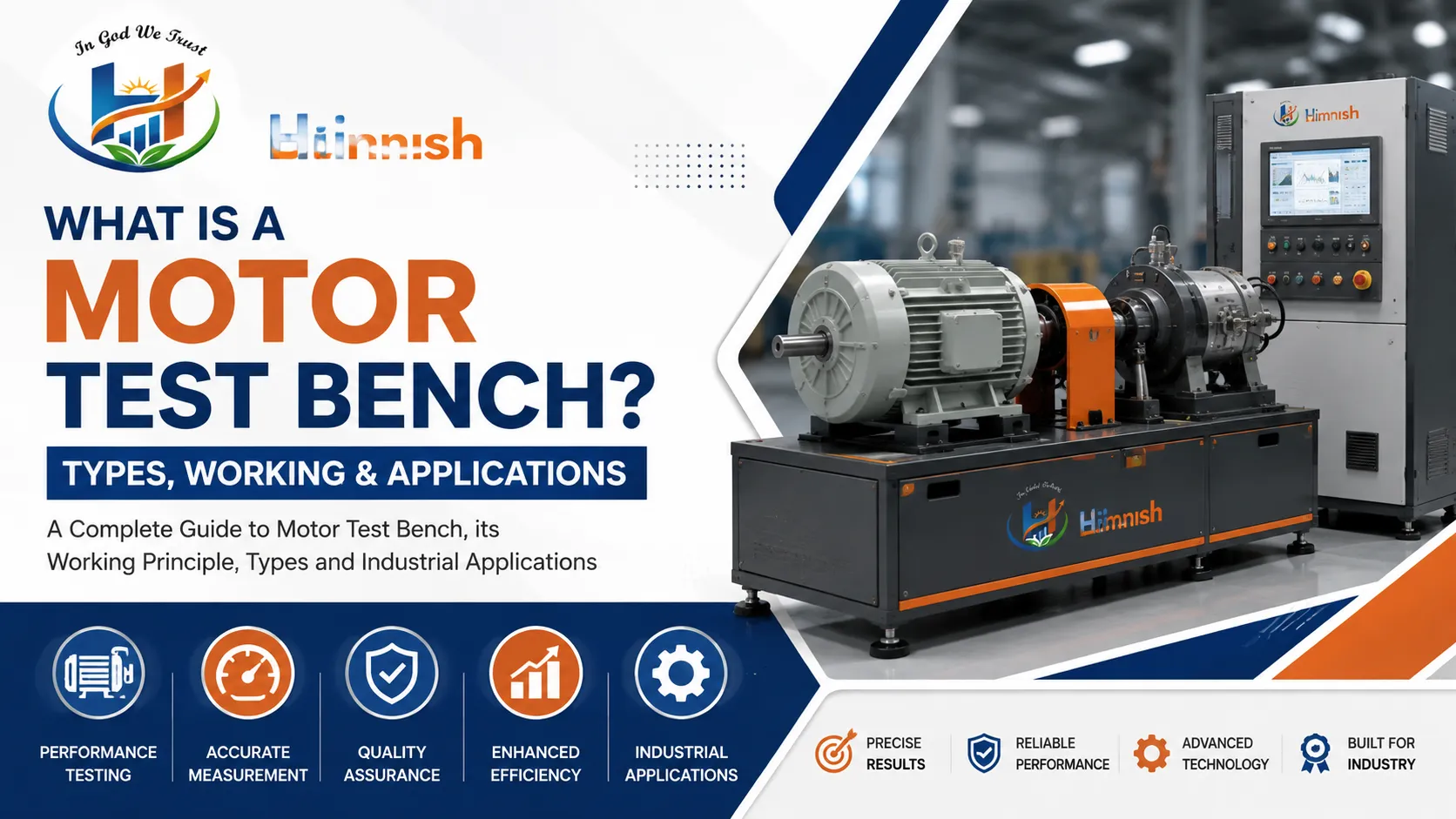
The rapid growth of industrial automation, electric vehicles, and smart manufacturing has significantly increased the demand for high-performance electric motors. Whether it’s an industrial machine, conveyor system, HVAC equipment, pump, compressor, or robotic arm, every motor is expected to deliver consistent performance, energy efficiency, and long service life. However, even a minor manufacturing defect can lead to reduced efficiency, excessive power consumption, unexpected downtime, or complete equipment failure.
To avoid these issues, manufacturers rely on a Motor Test Bench to evaluate motor performance before the product reaches the customer. A motor test bench helps verify whether a motor meets the required quality standards by testing it under real operating conditions. It measures important parameters such as torque, speed, efficiency, vibration, temperature, voltage, and power output to ensure reliable operation.
In this blog, we’ll explain What is a Motor Test Bench, how it works, its different types, key applications, and why it has become an essential part of modern manufacturing and quality assurance.
What is a Motor Test Bench?
A Motor Test Bench is a specialized testing system designed to evaluate the electrical and mechanical performance of electric motors under controlled conditions. It simulates real-world operating environments to ensure that a motor performs efficiently, safely, and consistently before it is installed in any equipment or machinery.
Instead of waiting for a motor to fail after installation, manufacturers use a motor test bench to identify defects during production itself. The system measures multiple performance parameters and compares them with predefined standards. If the motor fails to meet these standards, engineers can immediately identify the issue and make the necessary corrections.
Modern motor test benches are equipped with precision sensors, advanced software, and automated controls that provide accurate test reports within minutes. This not only improves product quality but also helps manufacturers reduce warranty claims, increase customer satisfaction, and maintain compliance with international quality standards.
Also Read: Why Vibration Monitoring Matters: The Key to Preventing Equipment Failure in Industrial Machinery
Why is a Motor Test Bench Important?
As industries continue to demand higher productivity and lower maintenance costs, the importance of motor testing has increased significantly. A motor is often the heart of industrial equipment, and any fault in its performance can affect the entire production process.
A Motor Test Bench helps manufacturers detect issues such as poor insulation, excessive vibration, overheating, incorrect torque output, or electrical imbalances before the motor leaves the factory. Early fault detection minimizes production losses and prevents costly breakdowns in the field.
Apart from quality control, motor testing also helps engineers optimize motor efficiency and energy consumption. Since electric motors account for a significant portion of industrial electricity usage, improving their efficiency can result in considerable long-term cost savings.
How Does a Motor Test Bench Work?
The working principle of a motor test bench is based on evaluating a motor under simulated operating conditions while continuously monitoring its performance. Initially, the motor is securely mounted on the test bench and connected to the required electrical supply. Various sensors are attached to measure mechanical and electrical parameters during operation.
Once the motor starts running, the test bench applies different load conditions using a dynamometer or load simulation system. These varying loads replicate actual working environments, allowing engineers to observe how the motor performs under different operating conditions.
Throughout the test cycle, the system records real-time data and analyzes it using advanced software. The results are then compared with standard performance values. If all parameters remain within acceptable limits, the motor passes the quality inspection.
This automated process ensures accurate, repeatable, and reliable testing for every motor.
Types of Motor Test Benches
Different industries require different testing solutions depending on the type of motor being manufactured. Some of the most commonly used motor test benches include:
- AC Motor Test Bench – Designed for testing induction motors, synchronous motors, and industrial AC drive systems.
- DC Motor Test Bench – Suitable for evaluating DC motors used in automation, battery-operated equipment, and electric vehicles.
- Servo Motor Test Bench – Used for testing high-precision servo motors commonly found in CNC machines and robotic systems.
- Universal Motor Test Bench – Capable of testing multiple motor types on a single platform, making it ideal for research laboratories and multi-product manufacturing units.
- End-of-Line (EOL) Motor Test Bench – Installed directly on production lines for final inspection before packaging and shipment.
- Customized Motor Test Bench – Designed specifically according to customer requirements, motor size, testing standards, and production capacity.
Selecting the right type of motor test bench depends on production volume, motor specifications, and the level of testing accuracy required.
Key Parameters Measured During Motor Testing
A motor test bench evaluates multiple performance parameters to ensure every motor delivers reliable and efficient operation. These measurements provide valuable insights into the motor’s overall health and performance.
Some of the key parameters include:
- Torque
- Speed (RPM)
- Voltage
- Current
- Power Output
- Motor Efficiency
- Temperature Rise
- Vibration Levels
- Noise Levels
- Insulation Resistance
Monitoring these parameters helps manufacturers identify potential defects before motors are installed in real-world applications.
Applications of Motor Test Benches
Motor Test Benches are widely used across various industries where electric motors play a critical role. Their ability to provide accurate and repeatable testing makes them an essential part of modern manufacturing.
They are commonly used in:
- Automotive and Electric Vehicle manufacturing
- Industrial Automation
- Pump and Compressor manufacturing
- HVAC Equipment
- Home Appliance Industry
- Robotics
- Aerospace
- Renewable Energy Systems
- Research & Development Laboratories
- Educational Institutions
As industries increasingly adopt automation and smart manufacturing technologies, the demand for advanced motor testing systems continues to grow.
Benefits of Using a Motor Test Bench
Investing in a high-quality Motor Test Bench offers several advantages beyond routine quality inspection. It enables manufacturers to improve production efficiency while delivering highly reliable products to customers.
Some major benefits include:
- Detects manufacturing defects at an early stage
- Improves motor performance and efficiency
- Reduces warranty claims and maintenance costs
- Ensures compliance with international quality standards
- Increases production consistency
- Supports automated testing and Industry 4.0 integration
- Generates accurate digital test reports
- Enhances customer satisfaction and product reliability
These benefits make motor test benches a valuable investment for manufacturers focused on quality and long-term performance.
Features of a Modern Motor Test Bench
Modern motor testing systems have evolved far beyond basic inspection equipment. They now incorporate intelligent technologies that improve testing accuracy and operational efficiency.
Key features include:
- High-precision sensors
- Automated testing cycles
- PLC and SCADA integration
- Real-time performance monitoring
- Digital data logging
- User-friendly HMI interface
- Remote diagnostics
- Customizable test programs
- High testing accuracy
- Low maintenance design
These advanced features help manufacturers streamline testing operations while ensuring consistent quality across every production batch.
Why Choose Himnish Projects?
When it comes to industrial testing and automation solutions, Himnish Projects is a trusted partner for businesses across multiple industries. We specialize in designing and developing advanced Motor Test Bench solutions that combine precision engineering, intelligent automation, and reliable performance.
Our motor test benches are customized according to customer requirements and are capable of testing a wide range of electric motors with exceptional accuracy. Whether your application involves automotive motors, industrial drive systems, servo motors, or customized electric machines, our solutions are designed to deliver reliable and repeatable results.
At Himnish Projects, we focus on providing innovative testing systems that improve quality control, reduce inspection time, and enhance production efficiency. Backed by experienced engineers and dependable after-sales support, we help manufacturers achieve higher productivity while maintaining the highest quality standards.
Conclusion
As industries continue to move toward automation and high-performance manufacturing, ensuring motor reliability has become more important than ever. A Motor Test Bench enables manufacturers to evaluate every motor under controlled operating conditions, ensuring it meets required performance, safety, and efficiency standards before reaching the customer.
From detecting defects and improving energy efficiency to reducing maintenance costs and supporting automated production, motor test benches play a vital role in modern quality assurance. By choosing advanced testing solutions from Himnish Projects, manufacturers can improve product reliability, optimize production processes, and deliver motors that perform consistently in even the most demanding industrial applications.