
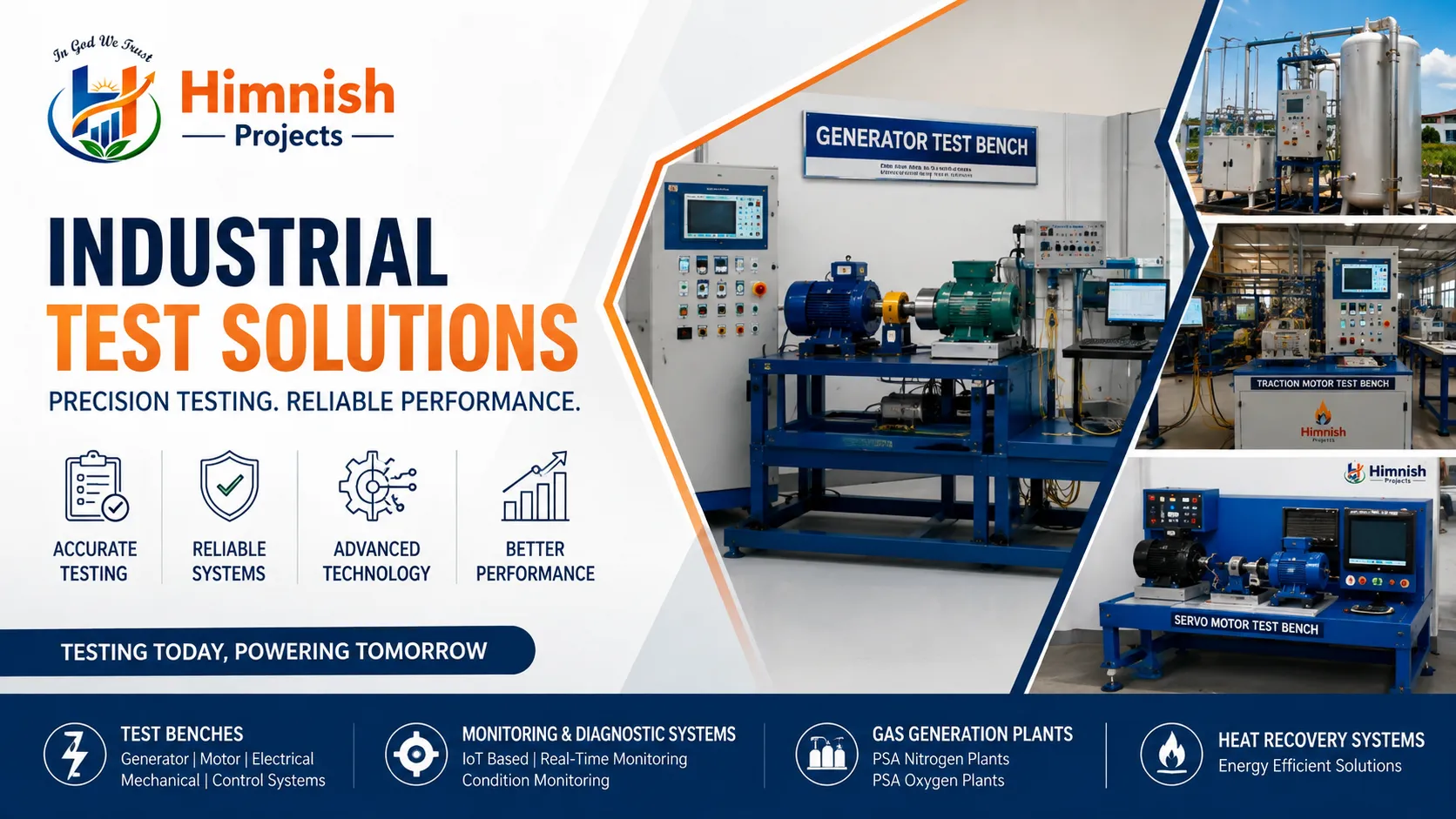
Testing is an essential part of modern manufacturing and engineering. Before electrical equipment, motors, generators, control systems, or mechanical components are delivered to customers, manufacturers need to verify that the equipment performs safely and reliably under defined operating conditions. This is where an industrial test bench becomes highly valuable.
A test bench provides a controlled platform where a product or component can be operated, measured, monitored, and evaluated. Depending on the application, it can simulate real operating conditions and collect important performance data. From electrical equipment testing to generator and mechanical testing, test benches are used across many industrial sectors.
Himnish Projects provides customized industrial testing and engineering solutions designed around specific equipment, testing requirements, measurement parameters, and production environments.
What Is a Test Bench?
So, what is a test bench? A test bench is a dedicated setup used to test, measure, inspect, or validate the performance of a machine, component, product, or system.
A basic test bench may consist of a supporting structure, testing equipment, measuring instruments, controls, power supplies, sensors, and data acquisition systems. More advanced systems can include programmable controllers, computer-based monitoring, automated sequences, safety interlocks, and specialized load arrangements.
The exact configuration depends on what is being tested.
For example, a generator test bench may be designed to evaluate voltage, current, frequency, load response, temperature, and other operating parameters. A motor test bench may measure torque, speed, power consumption, vibration, and efficiency. Therefore, a test bench is not simply a table or fixture. It is an engineered testing environment designed to produce reliable and repeatable results.
Also Read: IoT Temperature Monitoring: A Comprehensive Guide
What Is Bench Testing?
What is bench testing? Bench testing refers to the process of evaluating a product, component, or system using a controlled test setup before it is installed in its final operating environment.
Instead of testing equipment directly within a complete production system, engineers can isolate the equipment and examine its performance under controlled conditions.
Bench testing can be used during product development, manufacturing, quality inspection, troubleshooting, maintenance, and research.
For manufacturers, it provides an opportunity to identify performance issues before equipment reaches the customer or is integrated into a larger system.
How Does an Industrial Test Bench Work?
The working principle of an industrial test bench depends on the equipment being tested, but the basic process generally follows a structured sequence.
First, the equipment or component is securely connected to the test setup. Electrical connections, mechanical fixtures, sensors, communication interfaces, or other required connections are established.
Next, the test bench applies the required input conditions. These could include electrical power, mechanical load, pressure, speed, temperature, torque, or another controlled parameter.
Sensors and measuring instruments then collect performance data. The control system monitors the test parameters and compares the measured results with predefined limits or test criteria. If the equipment performs within the required range, it can be approved for the next stage. If an abnormal result is detected, engineers can investigate the issue before the equipment is released or installed. This controlled approach makes testing more systematic and repeatable.
Main Components of an Industrial Test Bench
A test bench can be customized extensively, but several components are commonly found in industrial testing systems.
Test Fixture
The fixture holds the equipment or component securely in the required position. Proper fixture design is important because movement or incorrect mounting can affect test results.
Power Supply
Electrical test benches require suitable power sources to provide the required voltage, current, or other electrical inputs.
Sensors
Sensors measure parameters such as temperature, pressure, vibration, speed, current, voltage, force, torque, or displacement.
Measurement Instruments
Meters, analyzers, data acquisition devices, and other instruments collect the information required for evaluating equipment performance.
Control System
A control system manages the test sequence and operating conditions. Depending on the application, it may use PLCs, HMIs, industrial computers, or dedicated controllers.
Load System
Certain equipment needs to be tested under controlled loads. A generator, motor, or power system test bench may therefore include an electrical or mechanical load arrangement.
Data Acquisition System
Modern test benches can automatically collect and record test data. This makes it easier to analyze results and maintain testing records.
Safety System
Industrial testing can involve high voltage, high current, rotating machinery, heat, pressure, or other hazards. Emergency stops, protective guards, interlocks, warning systems, and other safety features can therefore be incorporated into the design.
Types of Industrial Test Benches
Different products require different testing arrangements. Some common types include:
Electrical Test Bench
Electrical test benches are designed for testing electrical equipment, components, and systems. They can be configured to measure voltage, current, resistance, insulation characteristics, power, frequency, and other electrical parameters.
Generator Test Bench
A generator test bench evaluates generator performance under controlled loads and operating conditions. Depending on the application, parameters such as output voltage, current, frequency, temperature, efficiency, and load response can be monitored.
Motor Test Bench
Motor testing systems can measure speed, torque, power, efficiency, vibration, temperature, and other operating characteristics.
Mechanical Test Bench
Mechanical test benches are designed for evaluating mechanical components or assemblies. Depending on the application, they may measure force, displacement, torque, vibration, fatigue, or other mechanical characteristics.
Control System Test Bench
Control system test benches are used to verify the operation of control panels, controllers, automation systems, and related equipment before deployment.
Railway Equipment Test Bench
Specialized railway test benches can be designed for evaluating traction motors, coach equipment, electrical assemblies, and other railway components under controlled conditions.
Applications of Test Benches
The versatility of test benches allows them to be used across a wide range of industries.
Automotive and Engineering
Automotive and engineering companies use testing systems to evaluate motors, components, electrical systems, and mechanical assemblies.
Electrical Equipment Manufacturing
Manufacturers can use electrical test benches for quality control and performance verification before equipment is dispatched.
Power Generation
Generator and electrical testing systems help manufacturers and service organizations evaluate equipment performance under controlled load conditions.
Railway Industry
Railway manufacturers and maintenance facilities may use specialized testing systems for traction motors, coach equipment, control systems, and electrical components.
Industrial Automation
Control panels and automation equipment can be tested before being integrated into larger production systems.
Research and Development
During product development, engineers use controlled testing to compare designs, identify performance limitations, and validate prototypes.
Benefits of Industrial Bench Testing
Better Quality Control
Bench testing allows manufacturers to verify equipment performance before delivery.
Early Fault Detection
Potential problems can be identified before equipment is installed in the field, helping reduce costly failures later.
Repeatable Testing
A properly designed test bench can provide consistent testing conditions, making it easier to compare results between products.
Improved Product Reliability
Testing equipment under defined conditions can help identify weaknesses and support product improvements.
Faster Testing
Automated test sequences can reduce the time required for repetitive testing procedures.
Data-Based Decisions
Modern systems can record measurements automatically, giving engineers reliable data for analysis and quality documentation.
Reduced Field Failures
Testing products before installation can reduce the likelihood of performance problems after deployment.
Manual Testing vs Automated Test Benches
Traditional testing may require technicians to operate instruments manually and record readings individually. While this approach can work for simple applications, it may become time-consuming and inconsistent when large numbers of products need to be tested.
Automated bench testing can standardize test sequences and reduce unnecessary manual intervention.
A computerized system can automatically apply test conditions, collect measurements, identify abnormal results, and generate test reports.
However, automation should be selected according to the application. A simple product may not require a highly sophisticated automated setup, while complex high-volume manufacturing may benefit significantly from automated testing.
How to Choose the Right Test Bench?
Selecting a test bench begins with understanding the equipment that needs to be tested.
Consider the following factors:
- Equipment specifications: Voltage, current, power, speed, torque, weight, dimensions, or other operating parameters should be established.
- Testing requirements: Identify exactly which characteristics need to be measured or verified.
- Accuracy: Measurement instruments and sensors should provide suitable accuracy for the required test.
- Testing volume: High-volume production may benefit from automation and faster test cycles.
- Safety: The test system must account for electrical, mechanical, thermal, pressure, or other hazards.
- Data requirements: If detailed records are required, suitable data acquisition and reporting features should be incorporated.
- Future expansion: A modular design can make it easier to add testing parameters or capabilities later.
Why Choose Himnish Projects for Industrial Testing Solutions?
Industrial testing requirements vary significantly from one product to another. A standard test bench may not always provide the required combination of fixtures, sensors, controls, loads, measurement systems, and automation.
Himnish Projects develops industrial testing solutions based on specific application requirements. Customized test bench designs can be developed around the equipment being evaluated, required test parameters, production volume, safety requirements, and desired level of automation.
This application-focused approach helps businesses create testing systems that are practical for their actual manufacturing or engineering environment.
Conclusion
An industrial test bench is much more than a physical testing platform. It is a controlled environment that allows manufacturers and engineers to evaluate equipment performance, identify faults, collect data, and verify quality before products reach their final application.
Understanding what is a test bench and what is bench testing helps explain why these systems are increasingly important across electrical, mechanical, automotive, railway, power generation, and industrial automation sectors.
From electrical equipment and generator testing to motor, mechanical, control system, and railway applications, properly engineered test benches can improve quality control, support product development, reduce field failures, and make testing more consistent.
As industries move toward greater automation and data-driven manufacturing, advanced testing systems will continue to play an important role. With customized engineering and suitable automation, Himnish Projects can help businesses develop reliable industrial testing solutions designed around their specific equipment and testing objectives.